
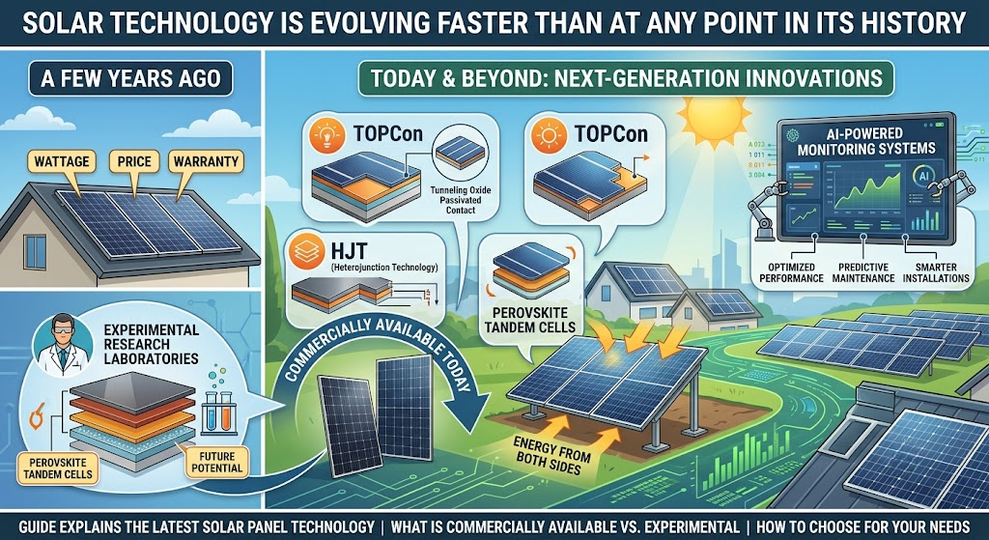
Solar technology is evolving faster than at any point in its history. Just a few years ago, homeowners choosing solar panels mainly compared wattage, price, and warranty. Today, buyers are also hearing about TOPCon, HJT, perovskite tandem cells, bifacial modules, and AI-powered monitoring systems.
These innovations are changing more than efficiency numbers. They are improving durability, reducing long-term energy losses, and making solar installations smarter than ever before. While many experimental technologies remain in research laboratories, several next-generation designs have already entered commercial production, giving consumers more choices than ever before.
This guide explains the latest solar panel technology, what is commercially available today, what is still experimental, and how to choose the right technology for your needs.
Why Solar Panel Technology Keeps Improving
Solar panels convert sunlight into electricity through photovoltaic (PV) cells. Every improvement aims to solve one or more common challenges:
- Generate more electricity from the same roof space
- Reduce efficiency losses in hot weather
- Extend panel lifespan
- Lower manufacturing costs
- Improve performance during cloudy conditions
- Integrate better with batteries and smart energy systems
In practice, efficiency gains may appear small on paper, but even a one- or two-percent improvement can translate into significantly higher electricity production over decades.
The Biggest Solar Panel Technologies Available Today
TOPCon Solar Cells
Tunnel Oxide Passivated Contact (TOPCon) technology has rapidly become one of the industry's leading innovations.
Compared with older PERC technology, TOPCon panels typically offer:
- Higher conversion efficiency
- Better low-light performance
- Lower degradation over time
- Longer performance warranties
Many leading manufacturers are transitioning toward TOPCon because production lines can often be upgraded without completely rebuilding factories, helping keep prices competitive.
Best for:
- Residential rooftops
- Commercial installations
- Hot climates
Heterojunction (HJT) Solar Panels
Heterojunction Technology combines crystalline silicon with thin-film layers.
Its major strengths include:
- Excellent temperature performance
- Higher efficiency
- Lower long-term degradation
- Better performance during cloudy weather
From a practical perspective, HJT panels are particularly attractive where summer temperatures regularly exceed 35°C because they generally lose less efficiency as temperatures rise.
Perovskite-Silicon Tandem Cells
Perhaps the most exciting development in solar research is the rise of perovskite tandem technology.
Instead of relying solely on silicon, tandem cells combine silicon with a perovskite layer that captures different wavelengths of sunlight.
Potential benefits include:
- Much higher efficiencies
- Lower manufacturing costs
- Lightweight designs
- Greater energy production per square meter
Laboratory efficiencies have surpassed many conventional silicon technologies, although large-scale manufacturing and long-term durability remain active areas of development. Commercial deployment is beginning, but widespread adoption will take time.
Bifacial Solar Panels
Traditional panels collect sunlight from one side.
Bifacial panels generate electricity from both the front and rear surfaces.
They work especially well when installed above reflective surfaces such as:
- White rooftops
- Concrete
- Sand
- Snow
- Light-colored gravel
Advantages include:
- Higher energy yield
- Better lifetime production
- Improved commercial project economics
One common mistake is assuming bifacial panels automatically increase production on every roof. Their benefits depend heavily on installation height, mounting design, and surrounding surfaces.
Back Contact Solar Panels
Back-contact designs place electrical connections behind the solar cells instead of on the front.
Benefits include:
- Reduced shading
- Improved appearance
- Higher efficiency
- Better reliability
Many premium residential solar systems now use back-contact technology to maximize energy production where roof space is limited.

Emerging Solar Technologies Worth Watching
Several promising innovations are moving from research toward commercialization.
Transparent Solar Panels
Researchers continue improving transparent photovoltaic glass that could eventually power:
- Office buildings
- Greenhouses
- Windows
- Skylights
Although not yet a replacement for conventional rooftop systems, transparent solar could significantly expand where renewable energy is generated.
Flexible Solar Panels
Flexible modules are becoming lighter, thinner, and easier to install.
Possible applications include:
- RVs
- Boats
- Portable power
- Curved roofs
- Emergency equipment
Recent research is also exploring ultra-lightweight solar materials for applications where conventional glass panels are impractical.
Building-Integrated Photovoltaics (BIPV)
Instead of attaching solar panels onto buildings, BIPV integrates solar generation directly into construction materials.
Examples include:
- Solar roof tiles
- Solar facades
- Solar windows
- Solar cladding
This technology is becoming increasingly attractive for architects seeking cleaner building designs.
Smart Solar Systems Are Becoming Standard
Modern solar installations now extend well beyond the panels themselves.
Today's systems increasingly include:
- AI-powered monitoring
- Smart inverters
- Battery integration
- Real-time energy management
- Mobile applications
- Automated fault detection
Many professionals notice that homeowners often save more by improving when they use electricity than by simply installing more panels.
Smart systems help maximize self-consumption and reduce reliance on the electrical grid.
Comparison of Modern Solar Panel Technologies
How Efficient Are Modern Solar Panels?
Modern premium residential panels commonly exceed 22% efficiency, while laboratory demonstrations of advanced tandem technologies have achieved much higher values under controlled conditions. Commercial products, however, prioritize long-term durability alongside efficiency.
Higher efficiency matters most when:
- Roof space is limited
- Electricity prices are high
- Long-term energy production is important
If roof space is abundant, a slightly lower-efficiency panel may still provide excellent overall value.
Choosing the Right Solar Technology
Instead of asking,
"Which panel is the most advanced?"
Ask,
"Which panel is best for my installation?"
Consider:
- Roof size
- Local climate
- Budget
- Electricity usage
- Warranty
- Manufacturer reputation
- Installer expertise
A high-quality installation often has a greater impact on long-term performance than choosing the newest panel technology.
Pros and Cons of Latest Solar Technologies
Advantages
- Higher efficiency
- Longer operational life
- Better low-light performance
- Reduced degradation
- Improved aesthetics
- Smarter energy management
- Better compatibility with battery storage
Limitations
- Premium technologies cost more
- Some innovations remain experimental
- Installation quality still determines system performance
- Not every roof benefits equally from every technology
Practical Tips Before Buying Solar Panels
- Compare efficiency and warranty together.
- Ask about annual degradation rates.
- Choose certified installers.
- Verify compatibility with future battery storage.
- Consider total lifetime energy production, not just upfront price.
- Review manufacturer support and replacement policies.
Common Mistakes to Avoid
- Buying solely based on wattage
- Ignoring inverter quality
- Choosing the cheapest installer
- Overlooking roof orientation
- Forgetting future battery expansion
- Assuming experimental technologies are already widely available
A simple way to avoid these problems is to request a complete system design rather than comparing panel specifications alone.
Expert Best Practices
Industry best practices include:
- Select proven manufacturers with strong warranty support.
- Use high-quality mounting systems.
- Keep panels free from excessive shading.
- Monitor system performance regularly.
- Schedule periodic inspections, especially after severe weather.
- Size the system according to realistic electricity consumption instead of maximizing panel count.
Solar Technology Trends for the Next Few Years
The next wave of innovation is expected to focus on:
- Commercial rollout of perovskite-silicon tandem modules
- Improved energy storage integration
- AI-driven optimization
- Lightweight solar materials
- Building-integrated photovoltaics
- More efficient back-contact designs
Researchers are also exploring novel panel architectures that improve light capture and lightweight structures inspired by natural designs, though these remain in development rather than mainstream products.
Checklist Before Investing in Solar
- ✅ Evaluate your annual electricity usage
- ✅ Measure available roof space
- ✅ Compare multiple installation quotes
- ✅ Check panel efficiency and degradation
- ✅ Understand warranty terms
- ✅ Verify installer certifications
- ✅ Plan for future battery storage
- ✅ Review local incentives and regulations
Conclusion
The latest solar panel technology is about much more than chasing higher efficiency figures. Modern innovations—including TOPCon, HJT, bifacial modules, back-contact designs, smart monitoring, and emerging perovskite tandem cells—are making solar systems more reliable, productive, and adaptable than ever before. While research continues to push the boundaries of what photovoltaic materials can achieve, the most practical decision for most buyers is to select a proven technology installed by a qualified professional and tailored to their energy needs. By focusing on lifetime performance, system quality, and future expandability rather than marketing claims alone, homeowners and businesses can make an investment that delivers clean energy and long-term value for decades.
Frequently Asked Questions
What is the newest solar panel technology?
Perovskite-silicon tandem cells are among the newest developments, while TOPCon and HJT technologies are already becoming widely available in commercial installations.
Are TOPCon panels better than PERC?
In many cases, yes. TOPCon panels generally provide higher efficiency, lower degradation, and better low-light performance than traditional PERC panels.
Should homeowners wait for perovskite panels?
Not necessarily. Today's premium silicon-based technologies already offer excellent performance. Waiting may not be worthwhile unless your installation timeline is flexible and future products meet long-term durability expectations.
Are bifacial panels worth it?
They can be highly effective in suitable installations, particularly ground-mounted systems with reflective surfaces. Their benefits are usually smaller on standard residential rooftops.
Do expensive panels always save more money?
Not always. Overall system design, local climate, installation quality, and electricity usage patterns often have a greater impact than panel price alone.
How long do modern solar panels last?
Most premium panels carry performance warranties of 25 years or more, although many continue producing electricity beyond their warranty period with gradual output reduction.
Discover the latest technology news on TechRera