HyperOS vs OxygenOS: Which Android Skin Offers the Best Experience in 2024?
The Android operating system ecosystem is celebrated for its unmatched diversity. Rather than locking users into a single rigid aesthetic, Google's open-source platform allows hardware manufacturers to craft unique software experiences that define their brand identity. For millions of smartphone enthusiasts worldwide, the choice of a new device often hinges more on its daily software interface than on raw hardware specifications.
Two of the most prominent custom interfaces dominating the global market are Xiaomi's HyperOS and OnePlus's OxygenOS. Both systems have undergone massive historical pivots over recent years. Xiaomi retired its legendary MIUI interface after thirteen years to introduce HyperOS, a unified operating system built to connect smartphones, tablets, smart home appliances, and electric vehicles. Meanwhile, OxygenOS transitioned away from its near-stock Android origins, merging its underlying codebase with parent company Oppo's ColorOS to emphasize battery efficiency and fluid physics-based animations.
In this comprehensive evaluation of HyperOS vs OxygenOS, we explore visual design philosophies, animation smoothness, multi-tasking capabilities, ecosystem interconnectivity, bloatware policies, gaming tools, and long-term software support to determine which interface delivers the superior daily experience in 2024.
Evolutionary Background: How Both Operating Systems Arrived Here
Understanding the distinct evolutionary backgrounds of both interfaces helps contextualize their design philosophies today.
The Genesis of HyperOS: Beyond Smartphones
In late 2023, Xiaomi officially announced the retirement of MIUI. While MIUI was praised for its deep feature set, it was notorious for inconsistent animation frame drops, fragmented background architecture, and aggressive background battery management. With HyperOS, Xiaomi re-engineered its software foundation from the ground up.
HyperOS merges standard Android with Xiaomi's proprietary Vela open-source IoT software system. By rewriting the low-level Linux kernel scheduling and unifying file systems across diverse hardware platforms, HyperOS was engineered to run seamlessly across devices with RAM configurations ranging from 64 kilobytes in smart lightbulbs to 24 gigabytes in flagship smartphones and connected electric cars.
The Evolution of OxygenOS: From Clean Minimalist to Unified Powerhouse
OxygenOS began its life as a darling of Android purists. In its early iterations on devices like the OnePlus 3 and OnePlus 7 Pro, OxygenOS closely mirrored Google's clean Nexus and Pixel software, adding only subtle, high-value tweaks like off-screen navigation gestures and customizable accent colors.
However, maintaining a completely separate software codebase while scaling global sales proved resource-intensive. In 2021, OnePlus integrated the development of OxygenOS into Oppo's ColorOS codebase. While this shift initially alienated vocal purists who lamented the loss of pure stock aesthetics, modern OxygenOS (versions 14 and 15) has matured into one of the most stable, resource-efficient, and visually fluid software skins available in the industry.
Visual Aesthetics and Design Language
Visual design strongly dictates your everyday satisfaction with any mobile operating system.
HyperOS: Layered Glassmorphism and Expressive Customization
HyperOS adopts a modern, highly expressive visual language characterized by layered glassmorphism, dynamic Gaussian blurs, and organic depth effects. Xiaomi took clear inspiration from modern desktop interfaces, emphasizing floating cards and subtle drop shadows that create a distinct sense of visual hierarchy.
The crowning achievement of HyperOS's visual design is its lockscreen customization suite. Inspired by contemporary mobile design trends, users can choose between Classic, Rhombus, and Magazine layouts. Deep depth effects allow clock numbers to tuck neatly behind subject hair or building skylines in portrait wallpapers, while real-time weather effects overlay interactive raindrops or sunbeams directly onto your lockscreen.
OxygenOS: Aquamorphic Fluidity and Calming Restraint
OxygenOS champions what OnePlus terms the "Aquamorphic" design system. The interface draws inspiration from natural water dynamics, utilizing soft rounded card edges, aquatic blue-and-orange accents, and soothing ambient color palettes that gently adapt depending on the time of day and battery status.
Unlike HyperOS, which embraces vibrant visual flair, OxygenOS exhibits remarkable visual restraint. System menus are spacious, typography is clean and legible, and settings menus are logically organized without clutter. OnePlus prioritizes clarity over ornamentation, making OxygenOS feel instantly familiar to users transitioning from vanilla Android.
Animation Fluidity and Navigation Responsiveness
True smoothness is defined by how an operating system manages gesture interrupts, inertia physics, and rendering pipelines.
HyperOS Animation Architecture
Xiaomi overhauled its rendering pipeline in HyperOS, introducing an advanced graphic subsystem that isolates animation calculations from background system processes. App opening and closing animations feature realistic physical inertia, with icons expanding gracefully from their home screen coordinates and snapping back smoothly if an ongoing gesture is canceled mid-swipe.
However, HyperOS can occasionally drop frames on mid-range and budget hardware (such as entry-level Redmi devices), where Xiaomi selectively disables advanced blur effects to preserve processor headroom.
OxygenOS: The Gold Standard in Parallel Processing
OxygenOS is widely celebrated as the benchmark for tactile smoothness in the Android ecosystem. Utilizing its Trinity Engine architecture, OxygenOS implements parallel animation processing. If you swipe up to return home while an app is still in the middle of launching, the system interrupts the frame seamlessly without stuttering or micro-jitters.
The touch response feels instantaneous, and velocity physics mimic real-world mass accurately. In day-to-day navigation, OxygenOS feels marginally more consistent and responsive under heavy multitasking loads than HyperOS.
Control Center and Notification Management
Alerts and quick device toggles fundamentally shape daily workflow efficiency.
HyperOS Control Center
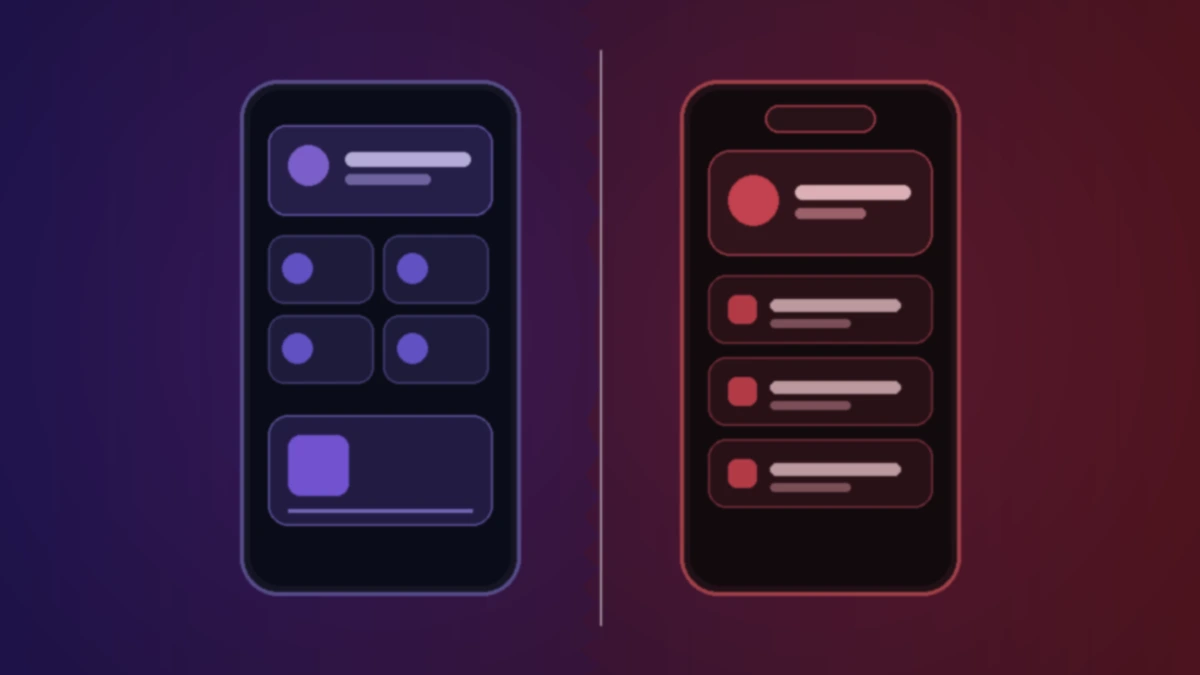
HyperOS completely separates notifications from quick settings toggles by default. Swiping down from the top-left edge reveals your chronologically organized notifications, while swiping down from the top-right brings up the expanded Control Center. The Control Center features large, iOS-style media playback cards, integrated brightness and volume sliders, and dedicated smart home device tiles for rapid IoT management.
OxygenOS Unified or Split Layout
OxygenOS offers greater user flexibility. While it supports a split control center similar to HyperOS, it also allows users to retain the classic unified Android shade, where a single swipe down reveals notification cards alongside quick toggle icons. OxygenOS also implements the "Fluid Cloud" (a dynamic pill interface surrounding the punch-hole camera) that displays active timers, screen recordings, food delivery tracking, and media controls without obscuring your current app.
Multitasking, Floating Windows, and Productivity
Both interfaces handle split-screen productivity with distinct, capable implementations:
- HyperOS Floating Windows: Xiaomi has mastered floating window management. Any application can be transformed into a floating card by swiping to the top corner. Windows can be resized freely, minimized into tiny floating side-bubbles, or docked into split-screen arrangements with smooth drag-and-drop file transfers.
- OxygenOS Flexible Windows & Open Canvas: OxygenOS features "Flexible Windows," which allows quick picture-in-picture app floating. On foldables and large flagships, OxygenOS introduces "Open Canvas," an extraordinary multitasking innovation that lets users keep three full-sized apps active simultaneously, smoothly sliding side-to-side across the screen rather than squeezing into cramped half-windows.
Ecosystem Integration and Multi-Device Connectivity
In the battle of HyperOS vs OxygenOS, multi-device ecosystem integration has become a major competitive battleground.
HyperOS: The Xiaomi Interconnectivity Suite
HyperOS is engineered as a cross-device nexus. When paired with Xiaomi tablets, laptops, and smart displays, HyperOS enables friction-free interoperability:
- Shared Clipboard: Copy text or images on your phone and paste instantly on your Xiaomi tablet or PC.
- App Handoff: Continue browsing articles or playing video seamlessly as you switch devices.
- Cross-Device Camera: Use your smartphone's high-resolution camera as a wireless webcam for your tablet or laptop.
- Home IoT Control: Deep native integration with the Mi Home ecosystem allows direct control of smart vacuums, air purifiers, and cameras directly from the notification shade.
OxygenOS: O-Work and Quick Link
OxygenOS provides seamless cross-device screen sharing and auto-connect hotspots with the OnePlus Pad and OnePlus laptops. Photos and documents transfer rapidly via O-Work, and cellular data can be shared without manual tethering setup. However, OnePlus's broader IoT hardware ecosystem remains substantially smaller than Xiaomi's extensive home catalog.
Gaming Performance and Optimization Tools
Both skins include dedicated gaming suites designed to maximize frame stability and minimize heat buildup during marathon gaming sessions:
HyperOS Game Turbo
Xiaomi's Game Turbo suite offers deep hardware tuning. Players can customize touch sampling response per game, set GPU performance profiles, activate voice changers, and monitor real-time CPU/GPU load along with frames per second (FPS). The Wild Boost optimization engine intelligently balances resolution scaling to prevent thermal throttling in intensive titles.
OxygenOS HyperBoost Gaming Engine
OnePlus equips OxygenOS with the HyperBoost engine, featuring GPA Frame Rate Stabilization. HyperBoost monitors thermal sensors 1,000 times per second to predict temperature spikes before they occur, gradually adjusting clock frequencies to prevent sudden frame drops. OxygenOS also includes a championship mode that blocks notifications, incoming calls, and accidental edge touches entirely.
Comprehensive Feature Comparison: HyperOS vs OxygenOS
The table below provides a detailed side-by-side comparison across all essential operating system categories:
| Category | Xiaomi HyperOS | OnePlus OxygenOS | Winning Advantage |
|---|---|---|---|
| Design Aesthetic | Layered glassmorphism, depth wallpapers, bold widgets | Aquamorphic curves, natural palettes, minimalist cards | Tie (Subjective visual preference) |
| Animation Consistency | Smooth on flagships; occasional frame drops on budget chips | Parallel multi-threaded animations; ultra-consistent | OxygenOS |
| Lockscreen Customization | Extensive depth effects, multi-layout fonts, live weather | Standard clock widgets, basic color customization | HyperOS (Significantly richer) |
| Multitasking & Windows | Free-floating resizable windows, corner gesture minimization | Flexible Windows + Open Canvas (exceptional on foldables) | Tie (Both excel at productivity) |
| Bloatware & Ad Policy | Varies by region; budget tiers feature promotional recommendations | Very clean; zero system ads, minimal pre-installed third-party apps | OxygenOS |
| Ecosystem Breadth | Massive IoT reach: tablets, wearables, smart home, EVs | Targeted: tablets, wearables, audio, select PCs | HyperOS (Far broader catalog) |
| Software Update Policy | Up to 4 years OS + 5 years security on flagships | Up to 4 years OS + 5 years security on flagships | Tie (Identical commitment on top tiers) |
| RAM Management | Aggressive background app caching to preserve battery | Trinity Engine keeps up to 30 apps resident in memory | OxygenOS |
Bloatware, System Advertisements, and Cleanliness
One of the most decisive considerations when comparing HyperOS vs OxygenOS is out-of-the-box software cleanliness:
The HyperOS Experience
On flagship devices (such as the Xiaomi 14 and 14 Ultra), HyperOS provides a premium, ad-free experience. However, on mid-range Redmi and POCO devices, the system still includes promotional application suggestions inside certain pre-installed tools (like the File Manager, Security app, and Themes store). While users can disable these recommendations through system settings, having to do so manually remains an annoyance for non-technical buyers.
The OxygenOS Experience
OxygenOS maintains an admirably clean environment across all price tiers, including the budget-conscious Nord line. There are zero push advertisements built into system applications. Pre-installed bloatware is limited to essential Google services, Netflix, and OnePlus community tools, almost all of which can be uninstalled or disabled in seconds.
Software Update Reliability and Longevity
Long-term software support directly impacts device longevity and security:
- OnePlus Commitment: OnePlus guarantees 4 major Android OS upgrades and 5 years of bi-monthly security patches on flagship devices (OnePlus 11, 12, and Open). Security updates roll out reliably and global stable builds are deployed on regular cadences.
- Xiaomi Commitment: Xiaomi matched this benchmark, offering 4 OS updates and 5 years of patches on its flagship series. However, regional rollout speeds can vary significantly, with Chinese firmware variants often receiving new features months ahead of European and global builds.
User Persona Guide: Which Software Fits You Best?
Choose Xiaomi HyperOS If:
- You love personalizing your device with dramatic lockscreens, custom fonts, and intricate themes.
- You own or plan to build a smart home using Xiaomi's vast ecosystem of cameras, vacuums, air purifiers, and lighting.
- You appreciate desktop-like floating window multitasking on large smartphone screens.
Choose OnePlus OxygenOS If:
- You value butter-smooth, uninterrupted gesture animations and rapid touch responsiveness above all else.
- You despise system advertisements, promotional push notifications, and stubborn bloatware.
- You prefer clean, organized settings menus and non-intrusive notification management.
Conclusion
The rivalry between HyperOS vs OxygenOS highlights two distinct, highly polished philosophies for the modern Android experience. Neither operating system is universally superior; each excels in areas tailored to different user priorities.
HyperOS is an ambitious, visually dazzling operating system designed for an interconnected world. Its lockscreen customization is the best in the industry, and its ability to bridge smartphones with extensive smart home hardware makes it unbeatable for ecosystem enthusiasts. On the other hand, OxygenOS is the master of refinement, fluidity, and everyday cleanliness. Its exceptional animation stability, bloat-free presentation, and reliable multitasking make it one of the most delightful interfaces to use daily.
Carefully evaluate whether you prioritize Xiaomi's expansive customization and smart home interconnectivity, or OnePlus's serene, ultra-fluid aesthetic to select the software that best elevates your mobile life.
Frequently Asked Questions (FAQs)
1. Is HyperOS completely different from MIUI or just a rebrand?
HyperOS is a genuine architectural overhaul rather than a simple cosmetic rebrand. While visual elements like the Control Center share familiarity, HyperOS rebuilds the low-level kernel scheduling, unifies file systems, reduces firmware storage footprint by several gigabytes, and integrates the open-source Vela IoT layer to communicate natively with smart home appliances and automotive systems.
2. Does OxygenOS still feel like pure stock Android?
No. OxygenOS has moved away from the vanilla Android aesthetic since merging its codebase with Oppo's ColorOS. Today, it features a distinct Aquamorphic design language with rounded card interfaces, custom shelf widgets, and proprietary quick settings. However, it still retains stock Android's clean, bloat-free spirit and avoids unnecessary clutter.
3. Which operating system delivers better battery life: HyperOS or OxygenOS?
In general day-to-day testing across comparable hardware, OxygenOS tends to deliver slightly better battery longevity. Its Trinity Engine CPU scheduler excels at managing idle background drain without aggressively terminating important notifications. HyperOS is also power-efficient, but its rich visual blur effects can draw marginally more energy under active screen-on usage.
4. Are there advertisements in HyperOS?
On flagship Xiaomi devices, HyperOS is completely free of system ads. However, on budget and mid-tier Redmi and POCO phones, promotional app recommendations may appear in default utility apps like the Themes store or File Manager. These recommendations can be permanently turned off in system settings.
5. Can I install third-party icon packs on HyperOS and OxygenOS?
OxygenOS allows direct application of third-party icon packs downloaded from the Google Play Store directly through the default home screen settings. HyperOS requires users to download icon themes through Xiaomi's dedicated Themes app, offering slightly less direct compatibility with standard Play Store launcher icon sets.
6. Which operating system is better for mobile gaming?
Both are exceptional for gaming. HyperOS's Game Turbo offers more granular manual tuning over touch sampling rates and GPU rendering parameters. However, OxygenOS's HyperBoost GPA engine provides slightly superior automated frame-rate stabilization, preventing sudden thermal stutter during extended competitive sessions in titles like PUBG Mobile or Genshin Impact.