OLED vs AMOLED Display: Key Differences, Advantages & Buying Guide
The display is the single most critical component of any modern smartphone, tablet, or wearable. It is the visual canvas through which we interact with every application, photograph, video, and communication tool. In recent years, marketing spec sheets have become inundated with an array of display acronyms: OLED, AMOLED, Super AMOLED, Dynamic AMOLED 2X, and LTPO. For the average consumer looking to upgrade their device, navigating these terms can be confusing.
At the center of this terminology lies the comparison between an OLED vs AMOLED display. While manufacturers frequently use these names interchangeably in consumer marketing, there are distinct architectural, electrical, and performance differences between foundational OLED technology and its active-matrix mobile descendant.
This comprehensive guide breaks down the core distinctions of an OLED vs AMOLED display, examining how self-emissive organic pixels function, the role of active-matrix backplanes, the power-saving benefits of LTPO variable refresh rates, peak brightness capabilities, eye comfort considerations like PWM dimming, and practical advice for choosing the best screen for your daily use.
The Core Physics: How OLED Technology Functions
To understand the distinction between an OLED vs AMOLED display, we must first look at the foundational technology that powers both: the Organic Light-Emitting Diode.
Self-Emissive vs Backlit Displays
Traditional Liquid Crystal Displays (LCDs) rely on a separate, dedicated backlight unit—typically an array of white LEDs positioned behind the screen or along its perimeter. Liquid crystal molecules act as microscopic mechanical shutters that twist and untwist to block or permit light to pass through red, green, and blue color filters. Because the backlight is always illuminated across large zones, LCDs cannot block 100 percent of light, resulting in washed-out dark scenes where true blacks appear dark gray.
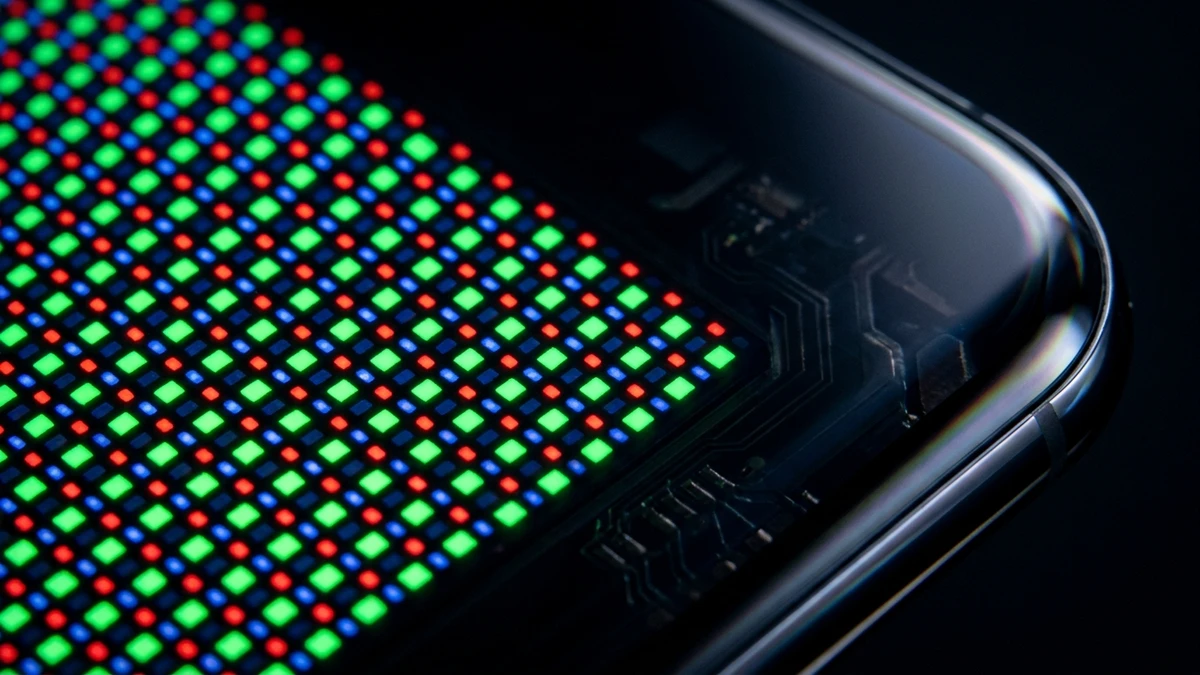
In stark contrast, an OLED display is completely self-emissive. Every single microscopic subpixel produces its own independent light when an electrical current passes through thin organic hydrocarbon films sandwiched between two conductors (an anode and a cathode). When an OLED screen needs to render black, it does not attempt to block light; it simply shuts off electrical power to those specific pixels entirely.
This self-emissive property provides three transformative visual advantages:
- Infinite Contrast Ratio: Because black pixels emit zero lumens, the mathematical ratio between the brightest white and the deepest black becomes functionally infinite.
- Instantaneous Pixel Response Time: OLED subpixels turn on and off in fractions of a millisecond (under 0.1ms), virtually eliminating motion blur and ghosting in fast-paced gaming and video playback.
- Ultra-Thin Physical Profiles: Eliminating the bulky diffuser sheets, light guide plates, and LED backlight modules required by LCDs allows OLED panels to be thinner than a millimeter, paving the way for curved edges and flexible folding phones.
The Technical Difference: OLED vs AMOLED
The fundamental distinction between an OLED vs AMOLED display lies in the electrical addressing system used to control each individual pixel.
PMOLED: Passive Matrix OLED
The original implementation of organic light-emitting technology was Passive-Matrix OLED (PMOLED). In a passive matrix, the display is structured with an array of conductive strips arranged in perpendicular rows and columns, with the organic light-emitting layers sandwiched at the intersections.
To illuminate a specific pixel, external integrated circuits apply voltage to that pixel's corresponding row and column. However, because there are no storage capacitors at individual pixel junctions, each row is activated sequentially line-by-line. To keep the screen appearing uniformly bright to human eyes, each pixel must be pulsed with high momentary voltage during its brief fraction of active time.
This design creates severe physical limitations. As display resolution increases, the number of rows multiplies, requiring exponentially higher voltages to maintain brightness. High voltage accelerates organic degradation, making PMOLED unsuitable for large or high-resolution screens. Today, PMOLED is restricted to tiny, low-information displays such as fitness bands, digital voice recorders, and basic secondary indicator screens.
AMOLED: Active Matrix OLED
Active-Matrix Organic Light-Emitting Diode (AMOLED) solved the scalability barrier by integrating a dedicated semiconductor backplane directly beneath the organic layers. In an AMOLED panel, every individual subpixel is paired with its own integrated electronic circuit consisting of at least two Thin-Film Transistors (TFT) and a storage capacitor.
This active architecture changes how power is delivered:
- The first transistor acts as a gate switch, addressing the specific pixel when receiving an instruction from the display driver.
- The storage capacitor captures and holds the exact electrical charge level.
- The second transistor acts as a continuous current driver, feeding a steady, controlled electrical flow to the organic subpixel throughout the entire refresh frame—even after the driver has moved on to address other lines.
Because each subpixel maintains continuous illumination without requiring high-voltage pulsing, AMOLED displays consume significantly less power, support massive resolutions (from Full HD+ to 4K), refresh at ultra-fast speeds (up to 144Hz or 165Hz), and scale gracefully to large smartphone, tablet, and laptop form factors.
In short: All AMOLED displays are OLED displays, but not all OLED displays are AMOLED. AMOLED represents the sophisticated active-matrix evolution that makes high-resolution mobile screens possible.
The Evolution of AMOLED: Super AMOLED, Dynamic AMOLED, and LTPO
Over the past fifteen years, display manufacturers (most notably Samsung Display and LG Display) have continually refined the active-matrix formula:
Super AMOLED
In early AMOLED panels, the touch-sensitive digitizer was a separate glass layer laminated on top of the display stack. This introduced an air gap that reflected ambient sunlight, causing outdoor visibility issues. Samsung engineered Super AMOLED by integrating capacitive touch sensors directly into the active display layers themselves (on-cell touch). Eliminating the separate touch layer reduced screen thickness, lowered internal reflections by 80 percent, and dramatically improved outdoor legibility.
Dynamic AMOLED and Dynamic AMOLED 2X
Introduced in modern flagship smartphones, Dynamic AMOLED incorporated certified HDR10+ support and shifted organic chemistry to deliver 100 percent coverage of the cinematic DCI-P3 color gamut. The "2X" designation signifies a doubling of the maximum refresh rate from traditional 60Hz to a silky-smooth 120Hz, paired with hardware-level blue light reduction to minimize eye strain.
LTPO AMOLED: The Variable Refresh Revolution
The most important mobile display breakthrough of recent years is LTPO (Low-Temperature Polycrystalline Oxide). Traditional AMOLED displays utilized backplanes made entirely of Low-Temperature Polycrystalline Silicon (LTPS). While LTPS provides excellent electron mobility necessary for driving crisp 120Hz refresh rates, it suffers from high electrical leakage when held at lower refresh rates.
LTPO solves this by blending LTPS transistors with Indium Gallium Zinc Oxide (IGZO) transistors. IGZO has virtually zero electrical leakage in an idle state. This allows modern LTPO AMOLED displays to dynamically scale their refresh rate on the fly:
- 1Hz: When reading static text, viewing photos, or on the Always-On Display, the screen drops to just 1 refresh per second, conserving massive battery power.
- 24Hz / 30Hz / 60Hz: Automatically synchronizes with video framerates to eliminate motion stutter.
- 120Hz: Instantly ramps to maximum speed the microsecond your finger touches the glass to scroll or play supported mobile games.
Comprehensive Display Technology Comparison
The table below provides a detailed breakdown comparing foundational OLED, standard mobile AMOLED, and cutting-edge LTPO AMOLED:
| Feature / Metric | Standard OLED (Passive Matrix / Basic) | Standard LTPS AMOLED | Advanced LTPO AMOLED |
|---|---|---|---|
| Backplane Type | Passive conductive strip grid | Low-Temperature Polycrystalline Silicon (LTPS) | Hybrid LTPS + Oxide (IGZO) |
| Refresh Rate Range | Fixed (typically 30Hz – 60Hz) | Fixed steps (e.g. 60Hz, 90Hz, 120Hz) | Fully adaptive (1Hz – 120Hz stepless) |
| Peak Local Brightness | 100 – 400 nits | 1,000 – 1,800 nits | 2,500 – 4,500 nits (modern flagships) |
| Power Consumption | High on large screens; low on tiny wearables | Moderate (constant power draw at 120Hz) | Ultra-Low (saves up to 25% battery life) |
| Contrast Ratio | Infinite (∞:1) | Infinite (∞:1) | Infinite (∞:1) |
| Pixel Response Time | Fast (< 0.5 ms) | Instantaneous (< 0.1 ms) | Instantaneous (< 0.1 ms) |
| Typical Applications | Fitness trackers, audio players, sub-meters | Mid-range smartphones, tablets | Premium flagships, luxury wearables |
Brightness Wars: Typical, High Brightness Mode (HBM), and Peak Nits
When shopping for devices featuring an OLED vs AMOLED display, brightness claims on spec sheets often cause significant confusion. Brands frequently advertise figures like "3,000 nits" or "4,500 nits." Understanding these metrics requires distinguishing between three measurement standards:
1. Manual Maximum Brightness
This is the maximum level of illumination you can achieve by manually sliding the brightness slider to 100 percent indoors. On modern AMOLED screens, this typically sits between 500 and 800 nits to protect against excessive battery drain and thermal buildup.
2. High Brightness Mode (HBM)
When the phone's ambient light sensor detects intense direct sunlight outdoors, the display engages High Brightness Mode across the entire screen. Modern quality panels deliver between 1,200 and 1,600 nits of sustained full-screen brightness in HBM, ensuring web pages, maps, and camera viewfinders remain easily readable under bright midday sun.
3. Peak Local HDR Brightness
The astronomical numbers quoted in marketing campaigns (such as 3,000 to 4,500 nits) represent peak local brightness. This measurement applies only to a tiny window (typically a 1% to 5% window size) displaying intense HDR specular highlights—such as sunlight glinting off chrome or a distant flashlight in a night scene—for a brief couple of seconds. While helpful for vibrant HDR video, it does not mean the entire screen can illuminate at that intensity continuously.
Eye Comfort: PWM Dimming vs DC Dimming
One critical health and comfort consideration surrounding AMOLED displays is Pulse-Width Modulation (PWM) dimming.
Because OLED subpixels alter their color temperature when driven with low voltages, manufacturers cannot simply reduce voltage to dim the screen. Instead, they rapidly flash the entire screen on and off hundreds or thousands of times per second. By varying the ratio of "on" time to "off" time (the duty cycle), human eyes perceive the screen as dimmer.
However, for approximately 10 to 15 percent of users sensitive to optical flicker, low-frequency PWM dimming (such as 240Hz or 480Hz) can trigger eye strain, dry eyes, and severe tension headaches after extended nighttime reading. In 2024, leading smartphone makers addressed this by introducing ultra-high-frequency PWM dimming (operating at 2,160Hz, 3,840Hz, or 4,320Hz) or hybrid DC-like dimming. At these ultra-high frequencies, flicker becomes completely imperceptible to human optic nerves, eliminating fatigue.
The Burn-In Question: Is Image Retention Still a Risk?
Historically, the primary criticism of OLED and AMOLED technology was the risk of permanent image retention, commonly known as burn-in. Because subpixels are organic, they gradually lose luminosity over thousands of hours of active emission. Blue subpixels, in particular, require higher energy levels and degrade faster than red and green elements. If static elements (such as navigation bars, signal indicators, or clock displays) remain permanently fixed in one location, those specific subpixels degrade slightly faster, leaving faint ghost outlines visible against solid gray backgrounds.
In modern smartphones, catastrophic burn-in has been effectively eradicated through three sophisticated hardware and software defenses:
- Pixel Shifting: Modern operating systems silently shift static status icons and clock digits by a few pixels every few minutes. This tiny movement is invisible to human eyes but distributes light emission across neighboring subpixels.
- Diamond PenTile Matrix: Display makers double the physical surface area of blue subpixels while arranging red and green subpixels in asymmetrical diamond grids, allowing blue emitters to operate at lower voltages with increased longevity.
- Subpixel Degradation Compensation: Display drivers constantly log cumulative operating hours per pixel region, algorithmically boosting voltage to aging pixels to ensure uniform screen brightness over years of daily usage.
Conclusion
When comparing an OLED vs AMOLED display, it is essential to remember that AMOLED is the direct, active-matrix evolution of foundational OLED technology. While basic passive OLED screens served early electronic indicators well, active-matrix AMOLED technology has completely revolutionized mobile visual experiences.
Today's cutting-edge LTPO AMOLED displays represent the pinnacle of consumer display engineering. They deliver infinite contrast ratios, blinding peak brightness for outdoor legibility, instant pixel response times for competitive gaming, and stepless variable refresh rates that protect battery life. If you are upgrading your smartphone or tablet in 2024, prioritizing an LTPO AMOLED panel with high-frequency PWM eye protection guarantees the richest, most comfortable visual experience modern technology can offer.
Frequently Asked Questions (FAQs)
1. Is AMOLED strictly better than OLED?
For smartphones, tablets, laptops, and smartwatches, yes. AMOLED utilizes an active-matrix backplane where each subpixel has its own transistor and capacitor. This allows high resolutions, fast refresh rates (up to 120Hz+), and lower power consumption. Foundational passive OLED cannot scale to high resolutions without overheating and degrading rapidly.
2. Does using Dark Mode really save battery on an AMOLED display?
Yes, significantly. Because AMOLED pixels are self-emissive, true black pixels consume zero power. Displaying a pure black background across system menus and supported apps can reduce display power consumption by 30 to 50 percent compared to displaying bright white backgrounds.
3. What does LTPO mean on a smartphone spec sheet?
LTPO stands for Low-Temperature Polycrystalline Oxide. It is an advanced display backplane that allows the screen to dynamically adjust its refresh rate from 1Hz (for static photos or reading) up to 120Hz (for smooth scrolling and gaming). This intelligent adaptation saves substantial battery life without compromising fluid responsiveness.
4. Can screen protectors reduce AMOLED display quality?
Cheap or thick matte screen protectors can introduce slight graininess, reduce peak brightness, and increase surface reflections. High-quality tempered glass protectors with oleophobic and anti-reflective coatings preserve virtually 100 percent of AMOLED clarity, contrast, and color vibrancy while safeguarding against scratches.
5. Why do some AMOLED screens look oversaturated?
By default, many smartphone manufacturers configure their display profiles to "Vivid" mode, which expands colors beyond standard sRGB to create eye-catching pop. If you prefer accurate, true-to-life tones for photo editing or natural viewing, switching your display color profile to "Natural" or "Standard" in system settings aligns the panel with industry-standard sRGB and DCI-P3 targets.
6. What causes eye strain on AMOLED screens at night?
Eye strain on AMOLED screens in dim environments is primarily caused by low-frequency Pulse-Width Modulation (PWM) dimming. Rapid screen flashing at low frequencies can tire ocular muscles. Selecting phones with high-frequency PWM dimming (over 1,920Hz) or enabling DC-like dimming options mitigates this flicker completely.