Snapdragon 8 Gen 3 vs Apple A17 Pro: The Ultimate Flagship Chipset Showdown
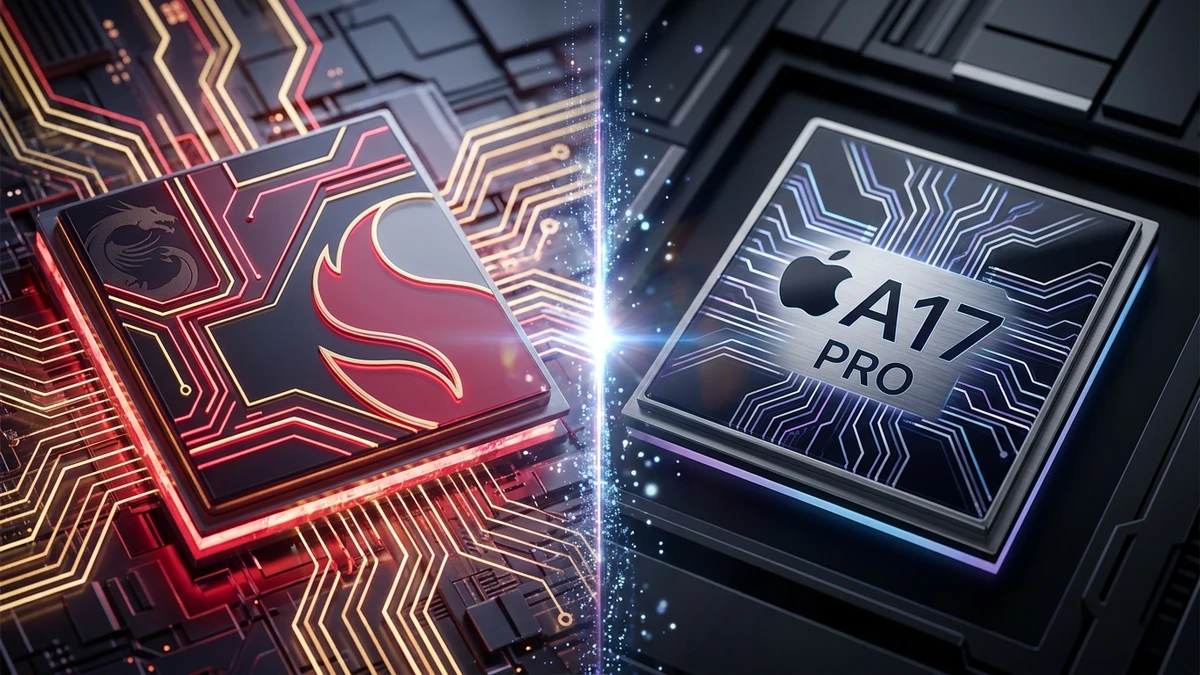
The rivalry between flagship mobile processors has never been more competitive. For years, Apple maintained an undisputed lead in single-core CPU throughput and architectural silicon density. However, with the arrival of Qualcomm's Snapdragon 8 Gen 3 alongside Apple's Apple A17 Pro, the power dynamics between Android and iOS hardware have shifted dramatically.
When comparing Snapdragon 8 Gen 3 vs Apple A17 Pro, consumers and tech enthusiasts are no longer looking merely at synthetic benchmark numbers. Modern mobile computing demands sustained GPU rendering, hardware-accelerated ray tracing, on-device generative AI execution, high-bandwidth memory pipelines, and advanced thermal dissipation. This comprehensive analysis breaks down both silicon giants across architectural design, benchmark metrics, gaming stamina, power efficiency, and everyday real-world utility.
Architectural Overview: 3nm vs 4nm Silicon Manufacturing
The physical fabrication process serves as the foundational battleground between these two mobile platforms. Apple secured exclusive early production access to TSMC's premier first-generation 3-nanometer lithography node (TSMC N3B) for the A17 Pro. In contrast, Qualcomm engineered the Snapdragon 8 Gen 3 on TSMC's refined second-generation 4-nanometer node (TSMC N4P).
While marketing materials frequently highlight the numeric disparity between 3nm and 4nm, practical silicon density and voltage scaling reveal a more nuanced story. The A17 Pro packs roughly 19 billion transistors into its die, emphasizing extreme single-thread logic speed. Qualcomm counterbalances the lithography difference with a radically overhauled core cluster arrangement that prioritizes multi-threaded parallel throughput and raw graphics horsepower.
Core Layout Comparison
- Apple A17 Pro: 6-core setup comprising 2 high-performance cores clocked at 3.78 GHz and 4 high-efficiency cores clocked at 2.11 GHz.
- Snapdragon 8 Gen 3: 8-core arrangement featuring a 1+5+2 cluster configuration: 1 prime Cortex-X4 core clocked up to 3.30 GHz, 5 performance Cortex-A720 cores (three at 3.15 GHz, two at 2.96 GHz), and 2 power-efficiency Cortex-A520 cores at 2.26 GHz.
By eliminating legacy 32-bit execution entirely and dedicating five distinct performance cores alongside the prime Cortex-X4, Qualcomm established a wider execution engine designed to handle demanding multi-core background tasks and computational threads simultaneously.
CPU Performance Analysis: Single-Core Velocity vs Multi-Core Muscle
The philosophical divergence between Apple and Qualcomm is vividly illustrated in standardized CPU evaluation suites like Geekbench 6 and SPECint.
In single-threaded execution, the Apple A17 Pro remains the industry pacesetter. Its microarchitecture features wider instruction decoders, massive L1 instruction and data caches, and an aggressive 3.78 GHz peak clock state. This single-core dominance translates to instantaneous application launches, lightning-fast web browser JavaScript execution, and immediate touch responsiveness across iOS.
However, the narrative pivots entirely in multi-threaded workflows. The Snapdragon 8 Gen 3 leverages its five Cortex-A720 performance units and dedicated prime core to outscore the 6-core A17 Pro in extended multi-core workloads. Whether compressing large video archives, rendering complex photo compositions, or running multitasking split-screen environments, Qualcomm's distributed processing model delivers sustained parallel throughput that matches or exceeds Apple's premier chip.
GPU Capabilities and Modern Gaming: Adreno 750 vs Apple 6-Core GPU
Historically, iPhones dominated mobile gaming graphics. With this generation, however, Qualcomm's Adreno 750 GPU has delivered a monumental leap, establishing a measurable lead in rasterization performance and sustained 3D stability.
Apple introduced a redesigned 6-core GPU architecture in the A17 Pro, highlighting support for hardware-accelerated ray tracing, mesh shading, and MetalFX upscaling. Apple notably ported console-grade titles such as Resident Evil Village, Death Stranding, and Assassin's Creed Mirage to iOS to demonstrate this computational prowess.
Nonetheless, intensive stress testing using 3DMark Wild Life Extreme and GFXBench reveals critical distinctions:
- Peak Graphics Output: In pure rasterized 3D rendering, the Adreno 750 delivers up to 15% to 20% higher peak frame rates compared to the A17 Pro GPU.
- Hardware Ray Tracing: In Solar Bay ray tracing benchmarks, Qualcomm's dedicated bounding volume hierarchy (BVH) hardware matches Apple's ray-tracing engines while sustaining higher thermal stability.
- Sustained Framerates: Because premium Android devices incorporate expansive vapor chamber cooling assemblies, Snapdragon 8 Gen 3 devices maintain stable frame delivery longer than the passively cooled titanium chassis of the iPhone 15 Pro.
Benchmark Scorecard: Synthetic and Gaming Testing
The following performance breakdown reflects standardized testing across calibrated retail devices under controlled ambient room conditions (22°C):
| Benchmark / Metric | Qualcomm Snapdragon 8 Gen 3 | Apple A17 Pro | Category Advantage |
|---|---|---|---|
| Geekbench 6 Single-Core | 2,250 – 2,320 | 2,900 – 2,980 | Apple (+25%) |
| Geekbench 6 Multi-Core | 7,200 – 7,500 | 7,250 – 7,450 | Equal / Competitive |
| AnTuTu Benchmark v10 | 2,080,000+ | 1,580,000+ | Snapdragon (+30%) |
| 3DMark Wild Life Extreme (Peak) | 5,050 points (30.2 fps) | 4,100 points (24.5 fps) | Snapdragon (+23%) |
| 3DMark Solar Bay (Ray Tracing) | 8,600 points | 6,750 points | Snapdragon (+27%) |
| Memory Support | LPDDR5X (up to 24GB, 4800MHz) | LPDDR5 (8GB, 3200MHz) | Snapdragon (Bandwidth) |
| Manufacturing Node | TSMC 4nm (N4P) | TSMC 3nm (N3B) | Apple (Node Density) |
Artificial Intelligence and Neural Engines: On-Device Intelligence
With generative AI becoming an integral part of modern operating systems, neural processing units (NPUs) have transformed from auxiliary sub-processors into core silicon drivers.
Qualcomm engineered the Snapdragon 8 Gen 3 with a dedicated focus on on-device multi-modal AI models. Its upgraded Hexagon NPU achieves up to 98% faster AI execution compared to its predecessor, processing large language models (LLMs) such as Meta's Llama 2 (up to 10 billion parameters) and Stable Diffusion image generation entirely offline on device. Token generation rates reach up to 15 to 20 tokens per second locally without relying on external cloud compute latency.
Apple's 16-core Neural Engine in the A17 Pro delivers up to 35 trillion operations per second (TOPS), operating at roughly twice the speed of the prior generation. Apple tightly pairs this engine with unified system memory to power Apple Intelligence, live speech transcription, real-time computational photography segmentation, and computational audio isolation. While Apple prioritizes seamless background integration across system apps, Qualcomm offers higher raw memory bandwidth (up to 77 GB/s versus Apple's 51.2 GB/s), providing an advantage for large local AI context windows.
Power Consumption, Thermals, and Sustained Efficiency
The relationship between silicon fabrication and energy efficiency is one of the most critical aspects of this matchup. TSMC's 3nm node provides Apple with exceptional low-voltage energy scaling. During modest tasks such as social media scrolling, web reading, and audio streaming, the A17 Pro draws minimal power, enabling remarkable battery longevity during light everyday use.
However, when pushed to absolute peak performance states, both chipsets encounter distinct thermal profiles:
- A17 Pro Under Heavy Load: When running sustained triple-A games, the A17 Pro's prime CPU cores and peak GPU clock states can draw upward of 11 to 14 watts momentarily. In compact devices lacking active heat spreaders, the phone quickly reaches thermal limits, prompting thermal throttling that reduces peak performance by 30% to 40% after 15 minutes.
- Snapdragon 8 Gen 3 Under Heavy Load: Qualcomm's platform similarly draws significant power at peak clocks (10 to 13 watts), but its wider multi-core distribution allows tasks to complete quickly at moderate frequency states. Furthermore, Android OEMs routinely pair this chip with expansive multi-layer graphite sheets and copper vapor chambers, yielding higher sustained frame stability in 60-minute stress loops.
Camera Image Signal Processors: Spectra vs Photonic Engine
Camera capabilities are deeply intertwined with silicon processing pipelines. The Qualcomm Spectra 18-bit triple ISP and Apple Photonic Engine represent two distinct philosophies in image pipeline architecture.
Qualcomm's Spectra ISP introduces cognitive real-time semantic segmentation up to 12 individual layers. The processor isolates hair, clothing, skies, skin tones, and background illumination in real time during live 4K video recording. It also natively supports 200MP photo capture, Dolby Vision HDR recording, and 8K computational video encoding.
Apple's image signal pipeline in the A17 Pro focuses on zero shutter lag, uncompressed ProRAW fidelity, and professional video codecs. The dedicated ProRes encoder and USB-C 3.2 Gen 2 controller permit direct video recording to external solid-state storage at 4K 60fps in Apple Log format, making the A17 Pro the preferred device for commercial video creators and filmmakers seeking standardized ACES color grading.
Connectivity and Modem Systems: Snapdragon X75 vs Apple Integration
Qualcomm's legacy in telecommunications provides an unmistakable advantage in wireless connectivity. The Snapdragon 8 Gen 3 incorporates the cutting-edge Snapdragon X75 5G Modem-RF System, featuring dedicated hardware AI tensor acceleration for cellular reception, 10-carrier sub-6GHz aggregation, and global Wi-Fi 7 speeds up to 5.8 Gbps.
The Apple A17 Pro integrates Qualcomm's prior-generation Snapdragon X70 cellular modem. While the X70 delivers exceptional 5G download and upload throughput, it lacks the enhanced mmWave/Sub-6 aggregation and energy-saving AI tracking introduced in the X75. For users in fringe cellular areas or high-density network environments, Snapdragon 8 Gen 3 devices frequently demonstrate faster handoffs and slightly reduced cellular battery drain.
Pros and Cons Summary
Qualcomm Snapdragon 8 Gen 3
- Pros: Market-leading rasterized and ray-traced GPU performance; superior multi-core computational horsepower; higher memory bandwidth (LPDDR5X); advanced on-device LLM generation; integrated Snapdragon X75 5G modem.
- Cons: High peak power consumption under unthrottled loads; depends heavily on OEM thermal chassis engineering to avoid throttling.
Apple A17 Pro
- Pros: Unrivaled single-core CPU throughput; cutting-edge 3nm transistor density; stellar low-voltage battery efficiency; native support for console game ports and ProRes Log video capture.
- Cons: Noticeable thermal throttling in slim titanium chassis during extended gaming; limited to 8GB of lower-bandwidth memory; slower multi-core performance scaling compared to eight-core alternatives.
Final Verdict: Which Chipset Takes the Crown?
The comparison between Snapdragon 8 Gen 3 vs Apple A17 Pro proves that neither manufacturer holds an absolute monopoly across all categories. Instead, each processor excels in distinct operational paradigms.
If your priorities center on single-thread snappiness, video production workflows, ProRes Log recording, and extreme power efficiency during light daily routines, the Apple A17 Pro remains an extraordinary engineering achievement. However, for mobile gamers seeking maximum sustained frame rates, power users running demanding multi-threaded tasks, and those exploring offline generative AI, the Snapdragon 8 Gen 3 represents the more versatile and graphics-dominant silicon platform this generation.
Frequently Asked Questions (FAQs)
1. Is Snapdragon 8 Gen 3 faster than Apple A17 Pro in gaming?
Yes. In both synthetic graphics tests (3DMark Wild Life Extreme) and real-world 3D gaming, the Snapdragon 8 Gen 3's Adreno 750 GPU consistently delivers 15% to 25% higher frame rates than the Apple A17 Pro. Furthermore, Android devices equipped with vapor cooling chambers sustain these frame rates longer without severe thermal throttling.
2. Does Apple A17 Pro have better battery life than Snapdragon 8 Gen 3?
In light to moderate everyday tasks (browsing, messaging, streaming video), the A17 Pro's 3nm manufacturing node provides superior energy efficiency, resulting in longer battery endurance. However, during continuous high-intensity gaming and 4K video rendering, both chips draw comparable power levels (10–13W).
3. Which processor is better for on-device AI tasks?
Both chips feature advanced neural engines, but the Snapdragon 8 Gen 3 holds an edge for running on-device large language models (LLMs) and Stable Diffusion image generation due to its higher memory bandwidth (up to 77 GB/s) and dedicated Hexagon NPU optimizations.
4. Why does Apple A17 Pro score higher in single-core benchmarks?
Apple designs custom high-performance CPU cores with exceptionally wide decoders, massive low-latency cache buffers, and higher peak clock frequencies (3.78 GHz), allowing individual application threads to execute faster than on standard ARM Cortex cores.
5. Can Snapdragon 8 Gen 3 run console games like Resident Evil?
Technically, the Adreno 750 GPU possesses more than enough compute and ray tracing power to render console-quality games. However, whether specific titles like Resident Evil appear on Android depends on publisher licensing and porting agreements rather than hardware limitations.
6. Which processor supports faster 5G and Wi-Fi connectivity?
The Snapdragon 8 Gen 3 includes the newer Snapdragon X75 5G modem with hardware AI acceleration and Wi-Fi 7 support up to 5.8 Gbps, whereas the A17 Pro uses the older Qualcomm X70 modem and Wi-Fi 6E.