For years, smart glasses have been stuck between an impressive demo and a product people actually want to wear every day. That is beginning to change. The latest generation is smaller, more fashionable, more useful, and increasingly powered by AI rather than trying to put a tiny smartphone display in front of your eyes.
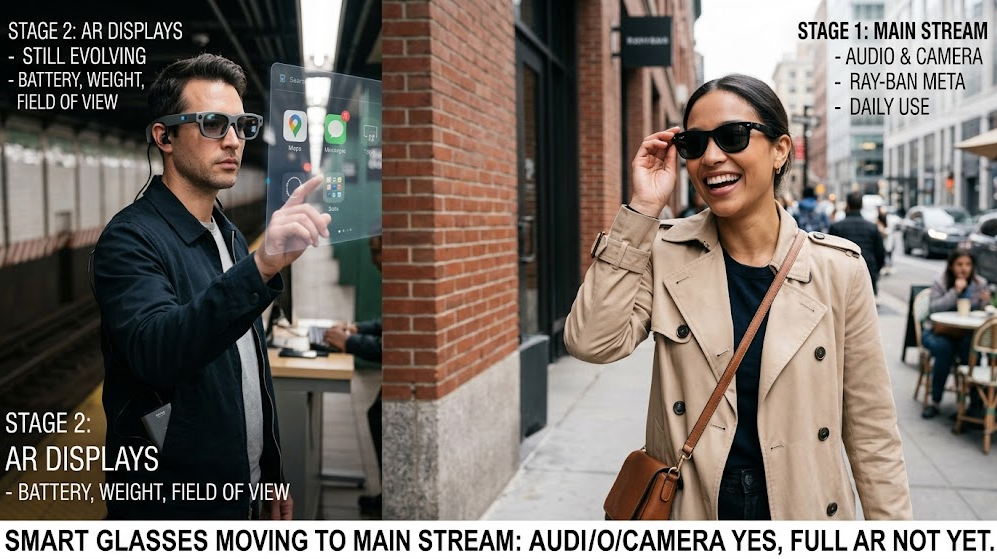
The important distinction, however, is that smart glasses are becoming mainstream in stages. Audio-and-camera glasses such as Ray-Ban Meta are much closer to everyday consumer technology than the bulky augmented-reality glasses of the past. At the same time, display-equipped glasses are still working through difficult problems involving battery life, weight, brightness, field of view, software, price, and social acceptance.
So, are smart glasses finally ready for mainstream use? For certain everyday tasks, yes. For replacing the smartphone or delivering full augmented reality, not yet.
Why Smart Glasses Are Suddenly More Practical
The biggest change is not simply better hardware. It is the combination of ordinary-looking eyewear and multimodal AI.
Earlier smart-glasses concepts often depended heavily on displays and specialized interfaces. Today's consumer products can instead make the camera, microphones, speakers, smartphone connection, and AI assistant useful without putting a screen in front of your eyes.
Ray-Ban Meta glasses are a good example. The current range combines cameras, microphones, open-ear speakers, Meta AI, calling, media controls, and hands-free photo and video capture in a conventional glasses form factor. Ray-Ban's current specifications list a 12-megapixel ultra-wide camera, five-microphone array, open-ear speakers, Wi-Fi 6, Bluetooth 5.3, and IPX4 water resistance for the current generation.
Google is pursuing a similar direction from another angle. Its Android XR platform is being developed specifically for glasses and headsets, with Gemini providing conversational assistance based on what the wearer can see and hear. Google announced in 2026 that its first Android XR audio glasses from partners including Gentle Monster, Warby Parker, and Samsung were planned for fall 2026, alongside development of display glasses.
That combination is important because it changes the basic proposition.
Instead of asking people to wear a computer on their face, manufacturers are increasingly asking them to wear normal-looking glasses that happen to contain a computer.
What Today's Smart Glasses Can Actually Do
Modern smart glasses are much more useful when viewed as a hands-free companion to a smartphone rather than as a smartphone replacement.
Depending on the model and region, current capabilities can include:
- Taking photos and videos with voice commands or a physical control
- Playing music and podcasts
- Making and receiving calls
- Sending messages
- Using an AI assistant
- Asking questions about something visible through the camera
- Translating text or speech
- Providing accessibility assistance
- Offering navigation-related information
- Streaming or sharing a first-person camera view
Ray-Ban's current documentation, for example, describes asking Meta AI about objects and signs the wearer is looking at. The glasses can send an image to Meta's cloud for AI processing and return an audio response.
That last detail matters. The AI is not simply responding to something typed into a phone. The glasses can potentially use what the wearer is seeing as part of the interaction.
That makes the device feel much more natural for certain situations.
AI May Be the Feature That Makes Smart Glasses Matter
The most compelling reason to wear smart glasses may not be augmented reality at all.
It may be AI that understands context.
Imagine walking through a city and asking for directions without reaching into your pocket. Or looking at a menu and asking for a translation. Or seeing an unfamiliar object and asking what it is.
Google demonstrated this idea with Android XR glasses in 2025, showing Gemini using the glasses' camera and microphones to understand the wearer's surroundings while speakers provide responses. Google also demonstrated optional in-lens displays for information that needs to be shown visually.
This creates a different kind of wearable computer.
The glasses can potentially become an interface between the physical world and digital information.
That is particularly interesting because the wearer does not have to constantly look down at a phone.
Smart Glasses Are Not All the Same
One reason discussions about smart glasses become confusing is that the term covers several very different products.
The distinction is crucial.
A pair of AI glasses that plays music and answers questions is considerably easier to make comfortable than a pair of glasses that must continuously project bright, correctly aligned graphics into the user's field of vision.
The Real Test Is Whether People Want to Wear Them
Technology can be technically impressive and still fail as a consumer product.
Google Glass demonstrated that lesson years ago. The original concept attracted enormous attention, but concerns around appearance, privacy, social behavior, price, and usefulness prevented it from becoming an ordinary consumer product.
The new generation is taking a different route.
Fashion partnerships matter because eyewear is already a familiar category. Ray-Ban Meta glasses are designed around established eyewear styles rather than looking like miniature computers attached to a person's face.
That seemingly simple decision may be one of the industry's most important improvements.
A technology product has a better chance of becoming mainstream when people do not feel that they are wearing a piece of experimental hardware.
Battery Life Is Better, But Still a Constraint
Battery technology remains one of the biggest limitations.
Small glasses frames have very little physical space for batteries, cameras, processors, radios, speakers, and other electronics.
Current Ray-Ban Meta specifications illustrate the trade-off. Ray-Ban lists up to four hours of use for its first-generation model and up to eight hours for the second-generation model under its stated conditions, with additional charging capacity supplied by the case.
Those numbers are meaningful improvements, but they should not be interpreted as equivalent to a phone's battery endurance.
Real-world battery life depends on what the wearer is doing. Heavy camera use, calls, AI interactions, streaming, and connectivity can place different demands on the hardware.
For mainstream adoption, people need to see the glasses as dependable eyewear rather than another device they have to remember to recharge constantly.
The Lack of a Display May Actually Be an Advantage
It sounds strange, but one reason current smart glasses can work is that many of them do not try to show information directly in front of your eyes.
Without a display, the glasses can remain relatively lightweight and familiar.
Audio can handle many tasks:
“What am I looking at?”
“Call Sarah.”
“Take a photo.”
“Translate this.”
“Play my podcast.”
That approach avoids many of the engineering difficulties associated with full augmented reality.
Google's Android XR strategy shows where the market may go next. Google has described two broad categories of intelligent eyewear: audio glasses that provide spoken assistance and display glasses that can show information visually.
This suggests the industry does not necessarily need to jump directly from ordinary glasses to full AR.
There is a middle ground.
Privacy Could Be the Biggest Mainstream Barrier
The technology may be ready before society is.
A camera hidden inside ordinary-looking glasses changes the social expectations around recording.
Current Ray-Ban Meta glasses include a recording indicator, and Meta has introduced measures intended to prevent or discourage tampering with that indicator. But the existence of a visible recording light does not eliminate the broader concern that people may not notice when someone is recording.
Recent reporting has documented growing controversy around camera-equipped smart glasses, including calls for restrictions or bans in some venues.
This is more than a technical problem.
Phones already allow people to record almost anywhere, but holding up a phone creates an obvious visual signal. Glasses are different because the camera can be pointed in the same direction as the wearer's gaze without the person obviously holding a recording device.
That means widespread adoption may require social norms, venue policies, technical safeguards, and potentially legal rules to develop alongside the hardware.
Accessibility Could Be One of the Strongest Use Cases
Smart glasses may have value beyond entertainment and convenience.
A camera combined with AI and audio can potentially help users interpret visual information without needing to hold a phone.
Current Ray-Ban Meta documentation highlights a feature that allows the wearer to make a hands-free video call with a sighted volunteer who can see through the glasses' first-person camera.
AI-based visual assistance can also potentially help identify objects, read text, translate signs, or describe surroundings.
The exact usefulness depends on the system's accuracy, connectivity, latency, battery life, and accessibility design. These systems should therefore be treated as assistance rather than infallible substitutes for human judgment.
Smart Glasses Still Depend Heavily on Phones and the Cloud
Another reason not to call today's smart glasses fully independent computers is that many rely on smartphones and cloud services.
Ray-Ban's documentation, for example, explains that visual questions sent to Meta AI involve sending a photo to Meta's cloud for processing before the response is delivered back through the glasses.
That architecture has advantages.
Cloud processing can provide access to much more powerful AI models than a tiny wearable could run locally.
But it also introduces dependencies:
- Smartphone connectivity
- Internet access
- Cloud processing
- Account requirements
- Service availability
- Privacy policies
- Regional feature restrictions
A smart-glasses experience can therefore be excellent when everything is connected but less useful when connectivity disappears.
Comfort May Matter More Than Raw Specifications
A pair of glasses can have an impressive camera and sophisticated AI, but if the frame is uncomfortable after several hours, consumers will stop wearing it.
Mainstream smart glasses have to solve several physical problems simultaneously:
- Weight distribution
- Frame thickness
- Heat
- Nose and ear comfort
- Lens options
- Prescription compatibility
- Battery placement
- Camera positioning
- Speaker quality
- Durability
This is where conventional eyewear companies have an advantage.
Companies such as Ray-Ban already understand that glasses are worn on the face for long periods. Technology companies need to match that level of comfort rather than simply fitting electronics into a frame.
What About Full Augmented Reality?
This is where the answer becomes much less certain.
True AR glasses need to put digital information into the user's physical environment while maintaining a convincing relationship between virtual content and the real world.
That creates difficult technical requirements involving:
- Brightness
- Field of view
- Optical quality
- Motion tracking
- Spatial mapping
- Latency
- Battery life
- Heat
- Weight
- Processing power
- Outdoor visibility
Google's Android XR work indicates that the industry is still developing this category. In 2025, Google showed Android XR glasses with an optional in-lens display, while its 2026 announcements distinguished audio eyewear from display eyewear.
So while AI glasses are moving toward mainstream use, full AR glasses remain a harder problem.
Are Smart Glasses Better Than Smartwatches?
Not necessarily. They solve different problems.
A smartwatch is excellent when information needs to be presented on a small screen or when health and activity sensors are important.
Smart glasses have a different advantage: they are positioned at the user's eyes, ears, and field of view.
That makes them naturally suited to:
- Hands-free communication
- Navigation
- Visual assistance
- Audio
- First-person capture
- Contextual AI
- Accessibility
The most likely future is not necessarily one wearable replacing another. Phones, watches, earbuds, and glasses could increasingly work together.
Who Should Buy Smart Glasses Now?
Smart glasses are most compelling today for people who have a specific reason to want hands-free technology.
They may be particularly useful for:
- People who frequently take photos or videos
- Users who want hands-free calls and audio
- People interested in AI assistants
- Travelers who value translation and navigation
- Users interested in accessibility features
- Early adopters comfortable with emerging technology
- People who already wear glasses and want integrated features
They are less compelling for someone expecting a completely independent AR computer that replaces a smartphone.
That product category has not fully arrived.
What Should You Look For Before Buying?
If you are considering smart glasses, do not judge them only by the camera resolution or AI marketing.
Check the following:
1. Comfort
Try the glasses on if possible. Weight and fit matter enormously for something worn on your face.
2. Battery performance
Look at the manufacturer's stated usage conditions rather than assuming the maximum advertised number represents every scenario.
3. AI capabilities
Check exactly which AI functions are available in your country and whether they require a phone, internet connection, or subscription.
4. Camera privacy
Understand how recording is indicated and how the manufacturer handles photos, videos, and AI processing.
5. Prescription support
If you normally wear prescription glasses, verify whether the specific model supports the lenses you need.
6. Ecosystem compatibility
Some glasses depend heavily on particular smartphone operating systems or companion apps.
7. Display requirements
Decide whether you actually need information displayed in your field of view. If not, audio-first glasses may offer a simpler and more mature experience.
The Smart-Glasses Market Is Finally Moving Beyond the Experiment
The evidence suggests that smart glasses are no longer merely a failed idea being repeatedly revived.
Meta's Ray-Ban partnership has demonstrated that consumers can accept connected glasses when the product looks and behaves sufficiently like conventional eyewear. Meanwhile, Google, Samsung, Qualcomm, and eyewear partners are building a broader Android XR ecosystem around AI-powered glasses.
But mainstream success should not be confused with universal adoption.
Recent reporting indicates that smart-glasses sales are growing rapidly, while privacy controversies are simultaneously becoming more visible.
That combination is telling.
The market's biggest challenge may no longer be proving that smart glasses can work. It may be proving that people can trust them, afford them, comfortably wear them, and use them without making everyone around them uncomfortable.
Are Smart Glasses Finally Ready for Mainstream Use?
Yes—but only if “mainstream” means useful everyday wearable glasses, not a complete replacement for the smartphone or a fully realized AR computer.
The current generation has crossed an important threshold. Cameras, open-ear audio, voice controls, AI assistants, calls, translation, navigation, and hands-free capture can now fit into products that resemble ordinary eyewear. Ray-Ban Meta's current hardware and Google's expanding Android XR platform demonstrate how quickly the category is developing.
The remaining obstacles are just as important as the technical achievements: battery life, privacy, comfort, connectivity, regional availability, AI reliability, and social acceptance.
The next major breakthrough may therefore not be a spectacular holographic display.
It may be something much less flashy: smart glasses that are good enough, comfortable enough, private enough, and normal enough that people simply stop thinking of them as technology.
Frequently Asked Questions
Are smart glasses ready for everyday use?
For specific tasks, yes. Current AI glasses can handle activities such as audio playback, calls, photography, voice assistance, and some AI-powered visual functions. They are not yet a universal replacement for smartphones or full AR systems.
Do smart glasses need a phone?
Many current models depend on a paired smartphone for connectivity, apps, or certain processing functions. The exact requirements vary by product and feature.
Can smart glasses see what I see?
Camera-equipped models can capture images from the wearer's viewpoint. Some AI features can use those images to answer questions about visible objects, signs, or surroundings. Ray-Ban explains that Meta AI can process a photo captured by the glasses and return an audio response.
Are smart glasses a replacement for smartphones?
Not currently. They are better understood as a complementary interface that can reduce the need to reach for a phone during certain tasks.
What is stopping smart glasses from becoming completely mainstream?
The biggest remaining challenges include battery life, privacy, comfort, AI reliability, connectivity, pricing, social acceptance, and—particularly for display-equipped models—the difficulty of fitting useful AR technology into lightweight everyday eyewear.
Conclusion
Smart glasses have reached an interesting point in their development. The technology is no longer just a futuristic demonstration, but it also has not become the universal computing platform that early AR predictions promised.
The strongest path to mainstream adoption appears to be gradual rather than revolutionary. Audio-first and AI-powered glasses can deliver useful features today without requiring users to stare at a display. Display and AR glasses can build on that foundation as optics, batteries, processors, and software improve.
The bigger question is now social as much as technical. People need to feel comfortable wearing cameras in public, bystanders need meaningful privacy protections, and manufacturers need to make AI behavior transparent and reliable.
If those problems are addressed, smart glasses may finally have the ingredient their predecessors lacked: a reason to wear them every day.