
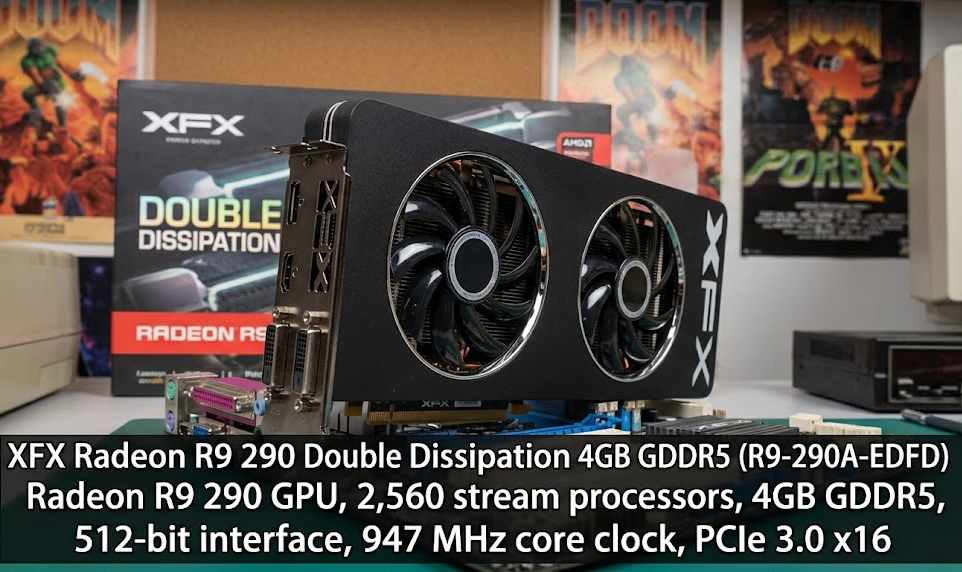
The XFX Radeon R9 290 Double Dissipation 4GB GDDR5 PCIe R9-290A-EDFD is a graphics card from AMD's Radeon R9 200 generation that was designed to deliver high-end gaming performance at a time when the Radeon R9 290 was one of AMD's important enthusiast GPUs. Its standout feature was not a radically different GPU, but XFX's custom Double Dissipation cooling system, which addressed one of the biggest concerns surrounding the reference R9 290: heat.
The R9-290A-EDFD uses the Radeon R9 290 GPU with 2,560 stream processors, 4GB of GDDR5 memory, a 512-bit memory interface, a 947 MHz core clock, and PCI Express 3.0 x16 connectivity. The card also provides two DVI-D outputs, HDMI, and DisplayPort 1.2.
Today, however, this is an older graphics card. That makes its specifications interesting for enthusiasts, retro PC builders, and people evaluating used hardware, but its age needs to be considered when judging modern gaming capability, driver support, power consumption, and second-hand value.
What Is the XFX Radeon R9 290 R9-290A-EDFD?
The R9-290A-EDFD is XFX's Double Dissipation version of AMD's Radeon R9 290. It is based on AMD's Hawaii Pro GPU architecture and was positioned below the R9 290X in AMD's original Radeon 200-series lineup.
The card combines AMD's R9 290 graphics processor with XFX's custom cooler. Rather than relying on the reference blower-style design, XFX used a large heatsink and two fans to move heat away from the GPU. Contemporary testing specifically identified the cooling system as the main attraction of this model.
There is also an important model-number detail worth knowing. R9-290A-EDFD is the regular Double Dissipation model, while XFX's R9-290A-EDBD was a higher-clocked Black Edition variant. A historical XFX rebate document lists the EDFD as the standard Double D R9 290 and the EDBD as the 980 MHz version.
XFX R9-290A-EDFD Specifications
The core and memory specifications are consistent across historical listings and reviews of the exact R9-290A-EDFD model. B&H Photo lists a 947 MHz core, 4GB of 1250 MHz GDDR5, 512-bit memory, 2,560 stream processors, and PCIe 3.0 x16.
The broader R9 290 specification also confirms the 512-bit memory bus and approximately 320 GB/s of memory bandwidth.
Why the 512-Bit Memory Bus Matters
The 4GB capacity is only part of the story. The R9 290's memory subsystem uses a 512-bit bus, giving the GPU substantially more memory bandwidth than many contemporary graphics cards with narrower interfaces.
At the card's 5,000 MHz effective memory speed, the theoretical memory bandwidth is around 320 GB/s. That bandwidth helps the GPU move large amounts of graphical data between its processor and VRAM.
For its original market, this was particularly useful for demanding games and higher-resolution rendering. It does not mean that 4GB of VRAM is automatically sufficient for every modern game, though. Current games can impose substantially different memory requirements, and the age of the GPU itself is now a much larger limitation than the memory bus.
XFX Double Dissipation Cooling
The defining feature of the R9-290A-EDFD is XFX's Double Dissipation cooling system.
The cooler uses two fans mounted over a substantial heatsink. Contemporary Hardware Canucks testing found that XFX's revised cooler helped the R9 290 maintain its clock more consistently while producing considerably better thermal and acoustic behavior than the reference design.
This was significant because the Hawaii-based R9 290 was known for generating considerable heat. The reference design could reach high temperatures and aggressively manage clocks, making cooling an important part of getting consistent performance.
The Double Dissipation cooler was therefore more than a cosmetic change. Its purpose was to give the GPU a better thermal environment and make sustained gaming less dependent on the limitations of the reference cooler.
Gaming Performance and the R9 290 GPU
When the R9 290 launched, it was a powerful enthusiast-class graphics processor. The GPU contains 2,560 stream processors, 160 texture units and 64 ROPs, with a 947 MHz reference-class clock for the EDFD model.
Historical reviews demonstrated that the card could deliver strong gaming performance for its generation. Hardware Canucks reported stable 947 MHz operation with the Double Dissipation cooler, while other reviews found considerable overclocking headroom on their individual samples.
Those historical results should not be interpreted as modern benchmark results. A game benchmark from 2014 or 2015 cannot directly represent performance in a 2026 PC gaming environment.
The important takeaway today is that the R9 290 remains a legacy performance GPU, rather than a modern gaming graphics card.
How the Double Dissipation Design Helped
The cooling system mattered because GPU performance is closely connected to temperature and power management.
When a graphics processor becomes too hot, its firmware and power-management system can reduce operating frequency to keep temperatures within the designed limits. Better cooling can make it easier for a GPU to sustain its intended clock.
Hardware Canucks specifically observed that the XFX cooler allowed its R9 290 sample to maintain a consistent 947 MHz boost clock, while the reference R9 290 had more difficulty maintaining its advertised operating frequency.
Another review from LanOC illustrates the same general issue from a different angle: its testing found that the card's default thermal target could allow temperatures into the low 90°C range, while increasing fan speed dramatically reduced temperatures.
This shows why cooling results should always be interpreted alongside fan settings, case airflow, ambient temperature, BIOS behavior, and the specific test methodology.
Power Requirements
The R9 290 is not a low-power graphics card.
Historical specifications put the GPU's board power in the roughly 250–275 W class, depending on the source and definition being used. AMD's R9 290 platform used one 6-pin and one 8-pin PCIe power connector, and board-partner specifications commonly recommended a 750 W power supply for systems using the card.
That recommendation does not mean the graphics card itself consumes 750 W. The figure represents the recommended capacity for the complete PC, including the CPU, drives, motherboard, fans, and other components.
For a used R9 290 system, the power supply deserves particular attention. A modern low-wattage PSU designed around an efficient contemporary GPU should not automatically be assumed suitable simply because it can physically power the card.
Video Outputs and Display Support
The R9-290A-EDFD provides a mixture of legacy and digital display connections:
- 2× Dual-Link DVI-D
- 1× HDMI
- 1× DisplayPort 1.2
These outputs reflect the display standards common when the card was released. B&H's historical specification listing confirms the same connector arrangement.
The inclusion of DisplayPort made the card useful for multi-monitor configurations, while DVI remained common on gaming monitors of that era.
Modern monitor setups may require adapters, particularly if the display only accepts newer connections. Adapter compatibility should be checked against the specific monitor and desired resolution rather than assumed.
Overclocking Potential
The R9-290A-EDFD was also known for having meaningful overclocking potential, although results naturally vary between individual cards.
One historical Bjorn3D test increased the GPU from 947 MHz to approximately 1,140 MHz and the memory from 1,250 MHz to around 1,375 MHz. Another test achieved a 1,120 MHz GPU clock and 1,400 MHz memory after increasing voltage.
These figures are historical test results from individual samples, not guaranteed operating frequencies for every R9-290A-EDFD.
Overclocking a card this old also introduces additional considerations. Thermal paste, fan bearings, VRM temperatures, power delivery, and previous usage can all affect how a second-hand sample behaves.
CrossFire Support
The Radeon R9 290 platform supported AMD's multi-GPU technology, and historical product listings for the XFX model identify CrossFireX support.
Multi-GPU configurations were once an interesting way to increase graphics performance, but modern games and applications do not universally scale across multiple GPUs. Driver and game support also became an increasingly important limitation as the industry moved away from traditional multi-GPU gaming.
For that reason, CrossFire support is better regarded as a historical feature of the card than a compelling reason to build a new multi-GPU system around it.
Strengths of the XFX R9 290 Double Dissipation
The card has several characteristics that made it attractive when it was new.
Strong memory subsystem: The combination of 4GB GDDR5, a 512-bit bus, and approximately 320 GB/s bandwidth was substantial for its generation.
Custom dual-fan cooling: XFX's Double Dissipation cooler was specifically designed to address the R9 290's thermal challenges.
High compute resources: With 2,560 stream processors and a Hawaii-based GPU, the R9 290 had substantial shader-processing capability for its era.
Overclocking flexibility: Historical testing demonstrated that some samples could operate significantly above the 947 MHz stock clock.
Limitations to Consider Today
The biggest disadvantage is simple: age.
The R9 290 belongs to AMD's older Radeon R9 200 generation. It was introduced in the era of Windows 7/8 gaming, DirectX 11 was dominant, and display technology was much less demanding than it is today.
Its 4GB VRAM can also become restrictive in newer games, particularly when high-resolution textures and modern rendering features are involved.
The GPU also lacks hardware ray-tracing acceleration found in much newer graphics architectures. TechSpot's specification database identifies the R9 290 as having no ray-tracing hardware.
Power consumption is another drawback. Compared with modern GPUs offering similar or better practical gaming performance, the R9 290's power requirements are relatively high.
Finally, buying a card this old means condition matters enormously. A used unit may have experienced years of thermal cycling, gaming loads, mining workloads, or fan wear. The model number alone cannot tell you the condition of an individual card.
Is the R9-290A-EDFD Still Useful?
It can still have a place in a legacy or budget PC, but expectations should be realistic.
It makes the most sense for someone building or maintaining an older gaming system where compatibility with older hardware is more important than access to modern GPU features.
Potentially suitable uses include:
- Older PC games
- Legacy gaming systems
- Older DirectX-based applications
- General desktop graphics
- Multi-monitor setups using its available outputs
- Hardware experimentation and enthusiast projects
It is much harder to justify as the foundation of a new high-end gaming PC. Modern GPUs generally provide much better efficiency and newer graphics features.
What to Check Before Buying a Used XFX R9 290
If you are considering an R9-290A-EDFD today, the condition of the individual card is arguably more important than its original specification sheet.
Check the following before buying:
- Fan condition: Make sure both fans spin properly and do not produce grinding or unusual bearing noise.
- Display outputs: Test every output you intend to use.
- Temperatures: Check GPU temperature under sustained load rather than only at idle.
- Artifacts: Look for visual corruption, crashes, driver resets, or black screens.
- Power connectors: Inspect the 6-pin and 8-pin connectors for damage or excessive heat discoloration.
- PCB and cooler: Look for corrosion, physical damage, missing screws, or evidence of major repairs.
- Thermal maintenance: An older card may benefit from new thermal paste and careful cleaning, although this should only be done by someone comfortable servicing graphics hardware.
- Power supply: Verify that the PSU has the appropriate PCIe connectors and sufficient capacity.
A used R9 290 that has been properly maintained can be very different from another unit that has spent years operating under heavy load.
Common Misconceptions About the XFX R9 290
Is the R9-290A-EDFD the Black Edition?
The model naming can cause confusion. Some historical retailers and reviews described the R9-290A-EDFD as a Black Edition, but XFX's model listings and historical product documentation distinguish the EDBD as the 980 MHz Black Edition while the EDFD is the standard Double D R9 290.
For identification purposes, the exact model number on the card or packaging is more reliable than a retailer's product title.
Does 4GB VRAM make it a modern 4GB gaming GPU?
No. VRAM capacity is only one part of GPU performance. The R9 290's 4GB memory was substantial for its generation, but the underlying GPU architecture, power efficiency, feature support, and driver ecosystem are now much older.
Is 947 MHz an overclock?
For the R9-290A-EDFD, 947 MHz is the listed core clock. The model should not be confused with XFX's higher-clocked EDBD variant.
Is the Double Dissipation cooler important?
Yes. It was one of the key differences between this XFX card and the reference R9 290 design. Contemporary testing found that the custom cooler improved thermal and acoustic behavior and helped the GPU maintain its operating frequency more consistently.
Frequently Asked Questions
What GPU is inside the XFX R9-290A-EDFD?
It uses AMD's Radeon R9 290 GPU, based on the Hawaii architecture. The card has 2,560 stream processors and a 947 MHz core clock.
How much VRAM does the XFX R9 290 Double Dissipation have?
It has 4GB of GDDR5 memory connected through a 512-bit memory interface. The listed effective memory speed is 5,000 MHz.
What power connectors does it use?
The R9 290 platform uses one 6-pin and one 8-pin PCIe power connector. Historical board specifications also commonly recommend a 750 W system PSU.
Does the XFX R9 290 support modern ray tracing?
No. The Radeon R9 290 does not have dedicated hardware ray-tracing acceleration.
Is the XFX R9 290A-EDFD worth buying today?
That depends heavily on the used price, card condition, intended games, power supply, and expectations. It can make sense for an inexpensive legacy or older gaming PC, but buyers should compare it with newer used GPUs before purchasing because the R9 290's age, power consumption, 4GB VRAM capacity, and lack of modern graphics features are significant limitations.
Conclusion
The XFX Radeon R9 290 Double Dissipation 4GB GDDR5 PCIe R9-290A-EDFD was an interesting implementation of AMD's Radeon R9 290 because XFX focused heavily on solving the GPU's thermal challenge rather than simply increasing clock speeds. Its 947 MHz GPU, 4GB GDDR5, 512-bit memory interface, 2,560 stream processors, and custom dual-fan cooler made it a serious gaming card in its original era.
Today, its role is different. It is primarily a legacy enthusiast GPU or used-budget option, and its original strengths need to be weighed against its age, relatively high power requirements, limited 4GB VRAM, and lack of modern graphics features. For anyone considering one on the second-hand market, the exact condition of the card and the price being asked are more important than the impressive specifications that made the R9 290 notable when it launched.