A solar battery spends much of its life doing something that ordinary batteries are not necessarily designed to do: charging and discharging repeatedly. That makes battery chemistry especially important in a solar power system.
When comparing a lithium battery vs lead acid battery for solar, the biggest differences are usable capacity, cycle life, charging efficiency, weight, maintenance, and upfront cost. Lithium iron phosphate (LiFePO4 or LFP) batteries generally offer higher usable capacity, better efficiency, deeper discharge capability, and much longer cycle life than traditional lead-acid batteries. Lead-acid batteries, however, remain relevant because their initial purchase cost can be lower and they are a well-established technology.
For a solar installation that cycles every day, these differences can have a significant effect on how much energy the system can actually use over its lifetime.
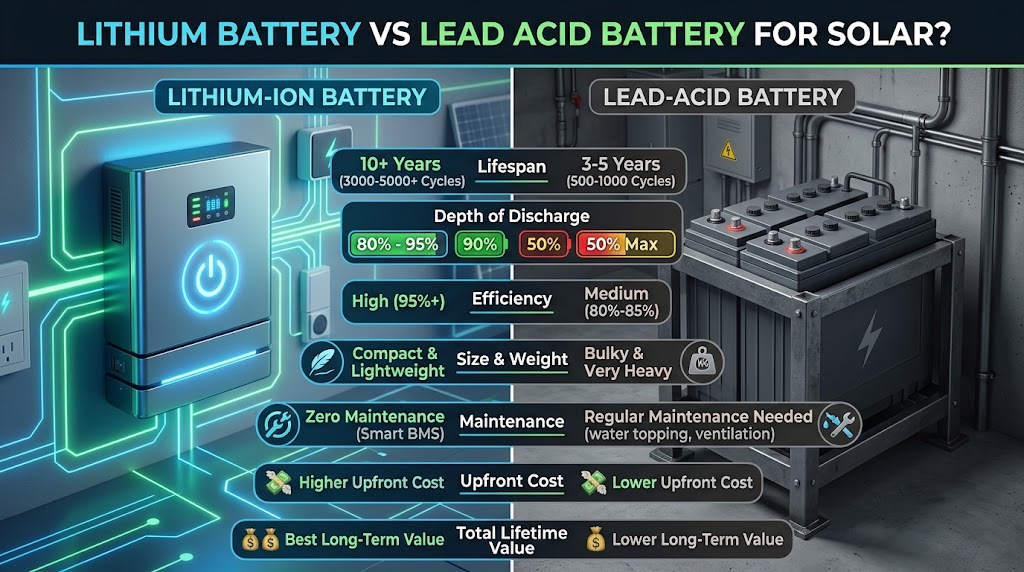
Lithium vs lead acid for solar at a glance
The exact specifications vary by manufacturer, battery model, temperature, discharge rate, and operating conditions. A battery's datasheet should always take priority over general comparisons.
Why battery chemistry matters in a solar system
A solar battery is not just an emergency power source. In many installations, it may cycle every day: charging when solar production exceeds immediate consumption and discharging when solar production is unavailable or insufficient.
That repeated cycling places different demands on a battery than occasional backup use.
Lead-acid batteries store electricity through an electrochemical reaction involving lead plates and a sulfuric-acid electrolyte. Lithium iron phosphate batteries use lithium-ion chemistry with an iron-phosphate cathode. These different chemistries affect charging behavior, discharge characteristics, efficiency, weight, and aging.
For solar applications, one of the most important differences is how each technology handles repeated partial discharge.
Victron notes that lead-acid batteries can suffer premature failure from sulfation when they spend extended periods partially charged, while LiFePO4 batteries do not require regular full charging in the same way.
Depth of discharge: one of the biggest differences
Depth of discharge (DoD) describes how much of a battery's stored energy has been used.
For example, if a 10 kWh battery has 5 kWh removed, it has experienced a 50% depth of discharge.
This matters because the battery's nominal capacity is not necessarily the same as the amount of energy you should routinely use.
Lead-acid batteries generally benefit from shallower discharge cycles. The appropriate limit depends on the specific battery, but repeatedly discharging a lead-acid battery too deeply can accelerate degradation. Victron's current documentation shows that cycle life varies substantially between lead-acid types and with depth of discharge.
LiFePO4 batteries can generally be discharged much more deeply. That means a lithium battery with the same nominal capacity can provide more usable energy within its recommended operating range.
For example, consider two hypothetical 10 kWh battery banks:
- A lead-acid system designed around a 50% usable depth of discharge provides about 5 kWh before reaching that operating limit.
- An LFP system designed around 80% usable depth of discharge provides about 8 kWh.
These are examples for explaining the concept, not universal specifications. The manufacturer's recommended DoD should always be used.
Cycle life and long-term solar use
A battery cycle represents a complete equivalent charge-and-discharge cycle. Real-world cycling can occur in partial stages, so manufacturers often specify cycle life at a particular depth of discharge and operating temperature.
The difference can be substantial.
For example, Victron's published comparison data includes an LFP battery rated at 2,500 cycles at 80% DoD and an AGM lead-acid example rated at 600 cycles at 50% DoD.
Its more general lithium-versus-AGM comparison also describes substantially longer cycle life for lithium batteries, although the exact figures depend on the particular products being compared.
This is why simply comparing the purchase prices of two batteries can be misleading. A cheaper battery may need replacement sooner, particularly when it is subjected to frequent daily cycling.
Charging efficiency
Solar energy is valuable partly because you want to make effective use of the electricity your panels generate.
Battery efficiency determines how much energy is lost while charging and discharging.
Victron documents an average round-trip efficiency of about 80% for lead-acid batteries and about 92% for LFP in one of its technical guides. It also notes that lead-acid charging becomes particularly inefficient at high states of charge, while LFP maintains higher efficiency.
The exact efficiency of a particular battery depends on the model and operating conditions, so these figures should not be treated as universal specifications.
In practical terms, higher efficiency means less of the solar electricity is lost during the battery storage process.
That can become particularly relevant in off-grid systems, where every available kilowatt-hour matters.
Charging speed
Lithium batteries can generally accept higher charging currents than comparable lead-acid batteries, subject to the manufacturer's specifications and the battery management system.
This can be useful in solar installations where the available charging window is limited.
For example, if clouds arrive in the afternoon and the system has only a short period of strong solar production remaining, a battery capable of accepting a higher charging rate may be able to capture more of that available energy.
Lead-acid batteries can also be charged effectively, but their charging behavior changes as they approach a high state of charge. Their absorption stage can take considerable time, and charging efficiency can decline.
The inverter, solar charge controller, battery cables, and battery itself must all be designed for the intended charging current.
Lithium batteries are much lighter
Weight can become a major issue as the required storage capacity increases.
Lithium batteries can provide considerably more usable energy for their weight than lead-acid batteries. Victron's published comparison, for example, shows a 200 Ah LFP battery at 56 kg alongside a 90 Ah AGM battery at 27 kg, although those batteries have different nominal capacities and should not be treated as identical products.
Another Victron document states that LFP batteries can save substantial space and weight compared with lead-acid technology.
For a small stationary home installation, weight may not matter much. For an RV, boat, mobile solar system, or installation where batteries must be carried upstairs, it can matter considerably.
Maintenance requirements
The amount of maintenance depends on the type of lead-acid battery.
Flooded lead-acid batteries require more attention because their electrolyte levels may need checking and maintenance according to the manufacturer's instructions. Other lead-acid designs, such as AGM and gel batteries, are sealed and generally require less routine maintenance.
Lithium batteries generally require little routine maintenance. However, that does not mean they are simply maintenance-free electrical components.
A LiFePO4 battery normally relies on a battery management system (BMS) to monitor and protect the cells. Depending on the battery design, the BMS can manage conditions such as overvoltage, undervoltage, excessive current, temperature, and cell imbalance.
That protection system is an important part of the lithium battery rather than an optional convenience.
What about partial charging?
This is another area where the two chemistries behave differently.
Lead-acid batteries can be damaged by spending extended periods in a partially charged state. One mechanism is sulfation, in which lead sulfate crystals become increasingly difficult to reverse. Victron specifically identifies prolonged operation in a state of charge deficit as a cause of premature lead-acid failure.
LiFePO4 batteries are much more tolerant of operating without being fully charged on every cycle.
This characteristic can be useful in solar systems where daily weather conditions mean the battery does not always reach 100% state of charge.
However, "lithium can remain partially charged" does not mean every lithium battery can be operated outside its specified voltage, temperature, or charging limits.
Performance under high loads
Battery capacity is not always as simple as the number printed on the label.
Lead-acid batteries can deliver less usable capacity when subjected to high discharge rates. This behavior is associated with the Peukert effect, which means available capacity decreases as discharge current increases.
Victron notes that higher loads can further reduce available watt-hours from lead-acid batteries compared with lithium-ion batteries.
Lithium batteries generally maintain their voltage and usable capacity better under higher loads, provided the battery is designed for the required current.
This can be particularly useful when a solar battery needs to supply appliances with relatively high startup or continuous power requirements.
The inverter's maximum output and the battery's continuous and peak discharge ratings must still be checked separately.
Upfront cost vs long-term value
This is where lead-acid batteries can remain attractive.
A lead-acid battery generally has a lower initial purchase cost than a comparable lithium battery. Victron describes lead-acid as a lower-initial-investment option while identifying lithium's longer cycle life and lower cost per cycle as advantages in larger off-grid applications.
But the purchase price is only one part of the calculation.
A more useful comparison considers:
Cost per usable kWh over the battery's service life
That calculation should include:
- Purchase price
- Usable capacity
- Expected cycle life
- Efficiency
- Replacement frequency
- Maintenance requirements
- Installation costs
- Applicable warranty
- Operating temperature
- Expected daily cycling
A low-cost battery may make sense for an application where it is rarely cycled. A more expensive lithium battery can make more sense where the battery is expected to cycle frequently for many years.
There is no single cost conclusion that applies to every installation because battery prices, warranties, specifications, and electricity requirements vary.
Lithium battery vs lead acid battery for solar: which lasts longer?
LiFePO4 generally has a substantially longer cycle life than lead-acid batteries when comparing products designed for their respective applications.
However, cycle-life figures should never be copied from one manufacturer's battery and applied to another.
A manufacturer's cycle rating may depend on:
- Depth of discharge
- Charge and discharge current
- Temperature
- End-of-charge voltage
- End-of-discharge voltage
- Rest periods
- Testing methodology
For example, a manufacturer might specify cycle life at 80% DoD, while another publishes a rating at 50% DoD. Those numbers are not directly equivalent.
Can you replace a lead-acid battery with lithium?
Sometimes, but not automatically.
A lithium battery may have a similar nominal voltage to the lead-acid battery it replaces, but the solar inverter or charger still needs appropriate charging settings and compatibility.
Victron's documentation, for example, identifies different settings for LFP batteries, including charge efficiency, discharge floor, and other battery-monitoring parameters.
Before replacing a lead-acid battery with lithium, check:
- Battery voltage
- Battery capacity
- Inverter compatibility
- Solar charge-controller compatibility
- Required charging voltage
- Maximum charging current
- Maximum discharge current
- BMS communication requirements
- Low-temperature charging restrictions
- Manufacturer installation instructions
A simple "drop-in replacement" should only be considered when the battery manufacturer explicitly supports that application.
Temperature considerations
Temperature affects both battery chemistries, but the way they respond can differ.
Lead-acid batteries experience reduced capacity in cold conditions, while high temperatures can accelerate aging. Lithium batteries also have temperature limits, particularly during charging.
A critical point with many LFP batteries is that charging at temperatures below the manufacturer's permitted range may be prohibited or require specific protection.
Some lithium battery systems therefore use BMS temperature monitoring or integrated heating systems.
The exact temperature limits should come from the battery's datasheet rather than a generic rule.
Which battery is better for off-grid solar?
Off-grid solar systems often place demanding requirements on batteries because the battery may be cycled frequently and may need to provide energy during long periods without sufficient sunlight.
LiFePO4 can be well suited to this type of operation because of its efficiency, deeper usable capacity, high cycle life, and tolerance of partial states of charge. Victron describes lithium as the newer standard for larger off-grid systems while also noting that lead-acid remains a viable option when users can manage its operating requirements.
Lead-acid may still be appropriate where initial investment is the dominant consideration or where the system's usage pattern does not demand frequent deep cycling.
The correct choice depends on the complete system rather than battery chemistry alone.
Which battery is better for backup power?
Backup power is a different use case from daily solar cycling.
If a battery sits fully charged most of the time and is only discharged during occasional power outages, the advantages of lithium's high cycle life may be less important than they are in a daily-cycling solar system.
Lead-acid can therefore remain a practical option for some backup applications.
For frequent outages or systems that cycle every day, the higher usable capacity and cycle life of LFP may become more relevant.
Common mistakes when choosing a solar battery
Comparing only amp-hours
A 100 Ah battery does not automatically provide the same amount of usable energy as another 100 Ah battery.
Voltage, discharge limits, efficiency, temperature, and recommended depth of discharge all matter.
Comparing nominal capacity instead of usable capacity
The energy you can routinely use is more important than the number printed on the label.
Assuming every lithium battery is the same
"Lithium" covers several chemistries. LiFePO4 is different from other lithium-ion chemistries, and specifications vary between products.
Using automotive batteries for solar cycling
Starting batteries are designed primarily for delivering high current for short periods, not for repeated deep cycling. A battery intended for solar storage should be specifically designed for that application. Victron's lead-acid classification shows substantial differences between starting, semi-traction, deep-cycle, AGM, and gel batteries.
Ignoring the inverter and charger
The battery cannot be evaluated separately from the charging system. Voltage, charging current, communication requirements, and protection settings all need to be compatible.
Frequently asked questions
Is lithium better than lead acid for solar?
LiFePO4 offers several characteristics that are useful for frequently cycled solar storage, including higher efficiency, deeper usable discharge, lower weight, and longer cycle life. Lead-acid can offer a lower initial cost and remains suitable for certain applications. The appropriate choice depends on the system's usage, budget, space, and charging requirements.
How long does a lithium solar battery last compared with lead acid?
There is no single lifespan that applies to every battery. Cycle life depends on depth of discharge, temperature, charging conditions, and the manufacturer's testing method. Published manufacturer data commonly shows substantially more cycles for LFP than comparable lead-acid batteries.
Can I use a lithium battery with my existing solar inverter?
Possibly, but compatibility must be confirmed. Check the inverter's supported battery chemistries, charging-voltage range, current limits, and any required BMS communication. Do not assume that a lithium battery is compatible simply because its nominal voltage matches the old lead-acid battery.
Do lithium batteries need a battery management system?
LiFePO4 batteries require appropriate cell monitoring and protection, and many commercially available batteries incorporate these functions into an integrated BMS. The BMS can help protect the battery from conditions such as excessive voltage, current, or temperature.
Is a 100Ah lithium battery better than a 100Ah lead-acid battery?
The two batteries may have the same amp-hour rating but different usable energy, weight, efficiency, discharge limits, and cycle life. Therefore, comparing only the 100Ah label does not provide a meaningful assessment. The complete specifications and recommended operating limits should be compared.
Conclusion
The choice between a lithium battery vs lead acid battery for solar comes down to how the storage system will actually be used.
LiFePO4 is particularly suited to applications involving frequent cycling because it generally offers greater usable capacity, higher efficiency, lower weight, and substantially longer cycle life. Lead-acid remains a practical technology where lower upfront cost, established equipment, or a particular operating pattern makes it appropriate.
For a serious solar-storage comparison, do not stop at the purchase price or amp-hour rating. Compare usable kWh, expected cycle life, charging efficiency, operating temperature, maximum charge and discharge current, warranty, maintenance, and compatibility with the inverter and solar charger.
Those details reveal what the battery is likely to deliver over its working life—and that is far more useful than simply asking which chemistry costs less to buy.