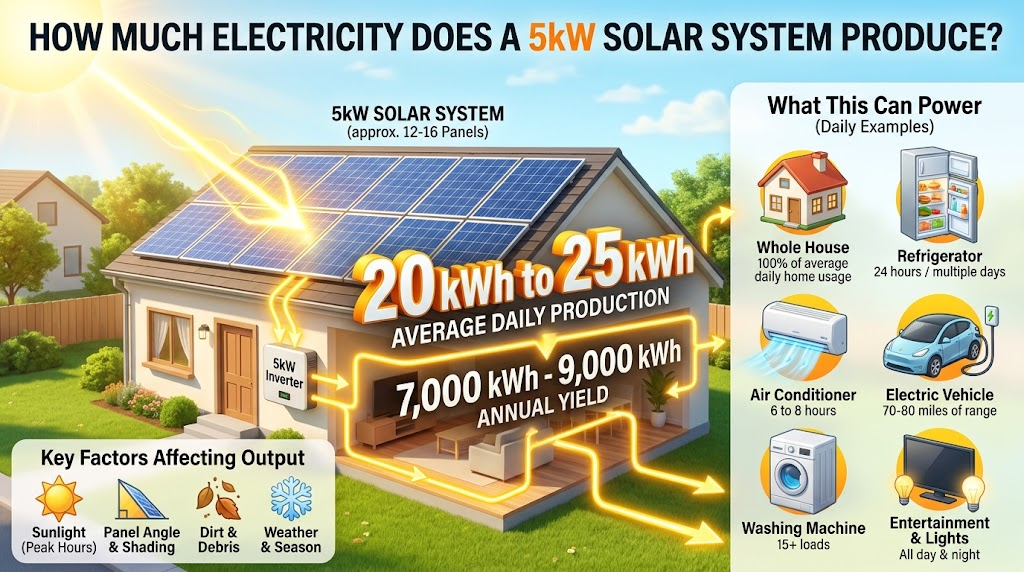
A 5kW solar system does not produce 5kWh of electricity every hour. The 5kW figure is the system's rated power capacity under specified test conditions. Actual electricity production varies throughout the day and across the year depending on sunlight, location, panel orientation, temperature, shading, system losses, and other factors.
For a useful estimate, a 5kW system can produce roughly 20–30 kWh of electricity on a good solar day when conditions provide around four to six equivalent full-sun hours and typical system losses are accounted for. That is an illustration rather than a universal output figure. A location-specific solar model such as NREL's PVWatts is more appropriate for estimating actual production because it incorporates solar resource, system configuration, and losses.
What does 5kW mean in a solar system?
The 5kW rating describes the maximum rated power of the solar array, not the amount of energy it produces in a day.
Power is measured in kilowatts (kW), while electricity generated over time is measured in kilowatt-hours (kWh).
For example, if a solar array could continuously produce 5kW for one hour, it would generate 5kWh of energy. In real-world operation, solar panels do not maintain their rated output throughout the entire day.
Solar irradiance changes from sunrise to sunset, and panel temperature, orientation, shading, wiring, inverter efficiency, and other factors affect the final AC electricity available to a home. NREL's PVWatts model specifically accounts for system capacity, array orientation, mounting, losses, inverter characteristics, and solar-resource conditions when estimating production.
How much electricity does a 5kW solar system produce per day?
A simple way to estimate daily production is:
Daily electricity production ≈ System size × equivalent peak-sun hours × system performance factor
For a 5kW system, consider three illustrative solar-resource conditions:
*These figures use a 14% illustrative system-loss assumption, consistent with the default aggregate system-loss value documented for NREL PVWatts. Actual losses can be substantially different depending on the installation.
This demonstrates why there is no single answer to the question. A 5kW installation in a location with strong solar resources can produce considerably more electricity than the same-sized system in a location with lower solar irradiation.
How much does a 5kW solar system produce per month?
Monthly production depends heavily on the season.
Using the same illustrative daily figures:
- 17.2 kWh/day × 30 days = about 516 kWh/month
- 21.5 kWh/day × 30 days = about 645 kWh/month
- 25.8 kWh/day × 30 days = about 774 kWh/month
These are scenario calculations, not guarantees. Actual monthly production can vary considerably because the number of usable solar hours changes with season and weather.
A solar system can also produce different amounts on two consecutive days. A clear day may deliver considerably more energy than a cloudy or heavily shaded day.
For a real installation, monthly estimates should come from location-specific solar-resource data rather than a generic "hours of sunlight" assumption. NREL's PVWatts system provides monthly and annual production estimates based on location and system characteristics.
How much electricity does a 5kW solar system produce per year?
Using the same simplified examples:
Again, these numbers are mathematical examples rather than predictions for every 5kW system.
A proper annual estimate needs local solar irradiation, panel orientation and tilt, system losses, inverter characteristics, and other design information. The World Bank's solar datasets, for example, provide long-term PV power-potential data for Pakistan, while NREL's PVWatts uses location-specific solar-resource information to estimate photovoltaic energy production.
Why doesn't a 5kW system produce 5kW all day?
This is one of the most common misunderstandings about solar power.
A panel's rated output is measured under standardized test conditions. Real sunlight changes continuously.
In the morning, solar output starts low. It rises as the sun becomes stronger and reaches its highest levels around the strongest part of the solar day. It then falls again toward sunset.
Even around midday, the system may produce less than its nominal rating because of:
- High panel temperature
- Cloud cover
- Dust and soiling
- Shading
- Panel orientation
- Wiring losses
- Module mismatch
- Inverter limitations
- Other system losses
NREL's PVWatts documentation identifies factors including soiling, shading, mismatch, wiring, connections, availability, and inverter performance as contributors to system losses.
The result is a changing production curve rather than a flat 5kW output throughout the day.
What factors affect 5kW solar production?
Location and solar resource
The amount of sunlight available at a particular location is one of the biggest factors.
Two identical 5kW systems installed in different countries—or even different parts of the same country—can generate different amounts of electricity.
Solar-resource datasets commonly express photovoltaic potential in terms such as kWh per kWp, which helps compare expected energy production at different locations. The World Bank's Pakistan solar dataset, for example, includes long-term PVOUT data measured in kWh/kWp.
Panel orientation and tilt
Panels need appropriate orientation and tilt to receive useful solar irradiation.
The ideal arrangement depends on geographic location and system design. NREL's PVWatts calculator includes array orientation and mounting characteristics among the inputs used to estimate production.
A poorly oriented array can produce less energy than a similarly sized system with better positioning.
Shading
Shade from trees, buildings, walls, chimneys, poles, or other structures can reduce production.
Even if only part of the array is shaded, the impact can depend on how the panels and electrical strings are configured.
NREL's PVWatts model includes shading among its system-loss considerations, illustrating why a simple calculation based only on panel capacity can overestimate real output.
Temperature
Solar panels generally do not perform at their rated power simply because the sun is bright.
Cell temperature affects photovoltaic output, and PV performance models account for temperature effects. NREL's PVWatts documentation includes cell temperature and module temperature characteristics in its modeling process.
This is one reason real-world output cannot be calculated from panel wattage alone.
Dust and dirt
Dust and soiling can reduce the amount of sunlight reaching the photovoltaic cells.
The effect varies according to the environment, rainfall, panel angle, surrounding pollution, and cleaning practices. NREL's PVWatts model includes soiling as one of its loss categories, with a default assumption in its standard model.
Inverter efficiency
Solar panels generate DC electricity, while most household appliances use AC electricity.
The inverter converts DC electricity into AC electricity. That conversion is not perfectly lossless.
NREL's PVWatts system design documentation includes inverter efficiency in its system modeling and notes a default nominal efficiency of 96% for the referenced model configuration.
The actual efficiency of a particular inverter depends on its design and operating conditions.
Does a 5kW solar system produce 5kWh per hour?
Not necessarily.
A 5kW system can produce up to around 5kW of power under appropriate conditions, but that does not mean it produces 5kWh during every hour of the day.
For example, an illustrative day might look something like this:
The actual values depend on the installation, weather, season, and location.
This distinction between power and energy is important when comparing solar production with household electricity consumption.
Can a 5kW solar system power a home?
It can, but whether it produces enough electricity for a particular home depends on the home's energy consumption and the local solar resource.
A household using relatively little electricity may be able to cover a large portion of its consumption with a 5kW system. A home with high-energy appliances, air conditioning, electric heating, pumps, or other substantial loads may require more generation or additional grid electricity.
It is also important to distinguish energy production from instantaneous power demand.
A home might consume 6kW at a particular moment even though its solar array is rated at 5kW. That does not necessarily mean the solar system is unsuitable. The difference could come from the grid, a battery, or reduced appliance operation depending on how the system is configured.
How much electricity can a 5kW system produce in winter?
Winter production depends on the location.
Shorter days, cloud cover, snow, seasonal solar angles, and shading can reduce energy production. In some regions, however, cold and clear weather can still provide strong solar output during available daylight hours.
Therefore, there is no universal winter-production figure for a 5kW system.
A location-specific model is preferable because annual and monthly production estimates depend on the site's solar-resource data. PVWatts provides monthly and annual AC energy estimates for this purpose.
Does adding batteries increase solar electricity production?
No. A battery generally stores electricity; it does not increase the amount of electricity the solar panels generate.
For example, if the panels generate 20kWh during a day, a battery does not turn that into 30kWh of solar generation.
A battery can, however, make more of the generated electricity useful at another time. Excess solar energy produced during the day can potentially be stored and used later, depending on the battery capacity, inverter configuration, charging limits, and system losses.
Because charging and discharging involve additional conversion losses, the amount of energy eventually delivered from the battery can be lower than the amount originally sent into it.
How many solar panels are needed for a 5kW system?
The answer depends on the wattage of the individual panels.
For example:
- With 400W panels: 5,000 ÷ 400 = 12.5 panels
- With 450W panels: 5,000 ÷ 450 ≈ 11.1 panels
- With 500W panels: 5,000 ÷ 500 = 10 panels
Because you cannot install half a panel, the actual number must be selected according to the system design and the precise DC capacity.
The inverter, roof space, string voltage, panel electrical characteristics, local installation requirements, and whether the quoted 5kW refers to DC array capacity or AC inverter capacity also matter.
NREL distinguishes between DC system capacity and AC inverter capacity, which is important when interpreting a system's "5kW" label.
What is a realistic way to estimate your own 5kW system?
Rather than relying on a generic daily number, use this process:
- Identify the exact system capacity. Confirm whether 5kW refers to the PV array's DC rating or inverter AC rating.
- Determine your location. Solar resource varies geographically.
- Check panel orientation and tilt.
- Assess shading. Trees and nearby structures can make a substantial difference.
- Account for system losses.
- Consider seasonal changes.
- Use a location-specific PV production model.
NREL's PVWatts calculator is designed to estimate grid-connected photovoltaic production using system size, location, array characteristics, and loss assumptions.
For an existing installation, the inverter's monitoring system can also provide useful real-world information such as daily, monthly, and lifetime energy production.
Common mistakes when estimating solar output
Mistaking kW for kWh
A 5kW rating describes power capacity. It does not mean the system produces 5kWh every hour.
Assuming peak sunlight lasts all day
Solar output changes from sunrise to sunset. The system's rated power is not a constant daily output.
Ignoring losses
Panels, wiring, inverter conversion, shading, dirt, temperature, and other factors affect the electricity that ultimately reaches the AC side of the system.
Using another home's production as a benchmark
A neighboring 5kW installation may have different panels, orientation, shading, weather conditions, inverter configuration, and maintenance.
Treating a daily estimate as a guarantee
Solar production is weather-dependent. A calculated annual estimate is more useful for planning than assuming the same output every day.
Frequently Asked Questions
How much electricity does a 5kW solar system produce in one day?
There is no universal figure. As an illustration, a 5kW system experiencing four to six equivalent peak-sun hours and a 14% modeled system-loss assumption would produce about 17–26 kWh per day. Actual production depends on location, weather, orientation, shading, equipment, and losses.
How much does a 5kW solar system produce per month?
A rough scenario using the figures above would be around 516–774 kWh in a 30-day month, but this should not be treated as a universal expected range. Seasonal solar conditions can cause substantial differences between months.
How much does a 5kW solar system produce per year?
Using the same illustrative assumptions, annual production would be approximately 6,278–9,417 kWh. A site-specific PV model should be used for a more meaningful estimate because solar resource and system design vary by location.
Can a 5kW solar system produce more than 5kW?
The answer depends on what the "5kW" rating refers to and the system design. A 5kW PV array is rated around 5kW DC under its specified test conditions, while actual instantaneous output depends on operating conditions. Some solar designs also use a DC array larger than the inverter's AC rating, so the system's DC and AC capacities should not automatically be treated as identical. NREL's PVWatts documentation explicitly distinguishes system DC capacity from inverter AC capacity.
Does a 5kW solar system produce the same amount of electricity every day?
No. Weather, season, solar angle, temperature, shading, soiling, and other factors cause daily production to change. A clear day and a cloudy day can have very different energy totals even when the solar system itself has not changed.
Conclusion
So, how much electricity does a 5kW solar system produce? The honest answer is that the number depends on where and how the system is installed.
A useful illustration is around 17–26 kWh per day under four to six equivalent peak-sun hours with a 14% modeled loss assumption, but this is not a guaranteed production range. Actual output can be lower or higher depending on local solar resources, weather, panel orientation, shading, temperature, equipment, and system losses. NREL's PVWatts model is specifically designed to make more meaningful location-based production estimates.
The key takeaway is simple: 5kW tells you the system's power capacity; kWh tells you how much electricity it actually generates. For anyone planning a solar installation, the annual and monthly kWh estimate is far more useful than the 5kW label alone.