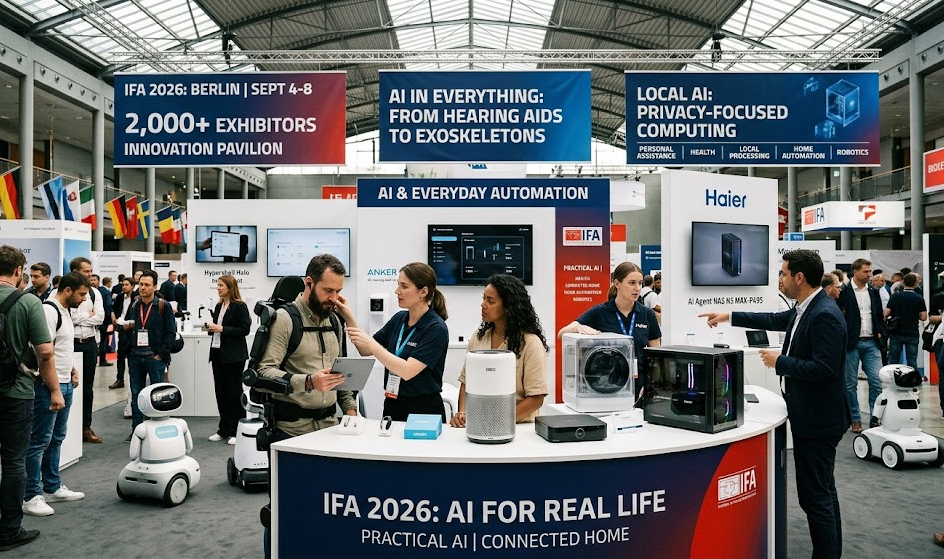
IFA 2026 made one thing clear: artificial intelligence is no longer confined to phones, laptops, and chatbots. At the Berlin technology show, AI appeared in hearing aids, home hubs, air purifiers, washing machines, exoskeletons, local AI computers, and even companion robots. The strongest products were not necessarily the ones with the biggest AI claims. They were the devices where AI had a practical job to do.
IFA 2026 ran from September 4 to 8 and brought more than 2,000 exhibitors and 240,000 visitors from 155 countries, according to IFA Berlin. The event also placed a strong emphasis on AI, robotics, connected homes, health, and everyday automation.
Among the most interesting AI gadgets were Anker's RIC Hearing Aids Pro, Anker MindBase, Minisforum's AI Agent NAS N5 MAX-P495, Hypershell Halo, DREO Air Purifier 530S, and Haier's AI-powered home appliances. These products show several different directions for consumer AI: personal assistance, local processing, physical augmentation, health, home automation, and privacy-focused computing.
The Best AI Gadgets from IFA 2026 at a Glance
Anker RIC Hearing Aids Pro — AI That Has a Clear Purpose
One of the more convincing AI products at IFA 2026 was not a computer at all. Anker's RIC Hearing Aids Pro use the company's Thus AI chip and a four-microphone deep-neural-network system to separate speech from background noise in real time.
That is a useful application of AI because the problem is specific: conversations can become difficult to follow when several people are talking or when there is significant background noise. Instead of simply adding an AI assistant to an existing product, the hearing aids use machine-learning processing to determine which sounds deserve emphasis.
Anker says the Thus AI chip performs 7.2 billion operations per second, while the company's internal testing reports a 30.2% improvement in speech clarity compared with another Anker SoC using the company's stated HASPI-based methodology. Because that is an internal company test, it should not be interpreted as an independent clinical comparison.
The hardware also has practical features, including Bluetooth 5.4, dual-device support, IP68 protection, up to 12 hours of hearing and Bluetooth use, and up to 36 hours with the charging case. A five-minute charge is rated for up to two hours of use.
Why it matters: This is a good example of AI becoming almost invisible. The user does not need to operate a chatbot or understand a model. The system simply attempts to make conversations easier to hear.
Anker MindBase — A Local AI Brain for the Smart Home
Anker's MindBase may be one of the more significant AI products from IFA 2026 because it addresses a problem that increasingly matters as homes accumulate connected devices: where should the intelligence and data actually live?
Anker introduced MindBase as a local AI home hub designed to combine connectivity, local computing, and local storage. The company positions it as a central system for its security, energy, cleaning, and audio ecosystems, with an emphasis on keeping data inside the home.
The system's TrueSmart Agent is designed for local AI processing. Forbes reported that the hub includes a 26-TOPS AI Core, Matter compatibility, and expandable storage of up to 48TB, while supporting security-camera analysis, event summaries, and smart alerts without depending entirely on cloud processing.
That local approach matters for privacy and responsiveness. Sending every camera event or household interaction to a remote server is not always desirable. Processing information locally can reduce the amount of sensitive data that leaves the home.
MindBase also reflects a broader shift from the traditional smart-home model. Instead of asking users to control dozens of independent devices, the goal is to create a central intelligence layer capable of coordinating them.
Why it matters: If local AI becomes common in consumer hardware, products such as MindBase could become the infrastructure behind more private and autonomous smart homes.
Minisforum AI Agent NAS N5 MAX-P495 — Local AI Without Sending Everything to the Cloud
For users who want serious AI processing at home, Minisforum's AI Agent NAS N5 MAX-P495 was one of the more technically interesting announcements at IFA 2026.
The device combines network-attached storage with local AI computing. Minisforum says the system uses AMD's Ryzen AI Max+ PRO 495 processor and can deliver up to 131 TOPS of AI compute performance. It supports up to 192GB of memory and up to 200TB of local storage.
The idea is particularly relevant to people experimenting with local large language models and AI agents. Rather than treating a NAS purely as a place to store files, Minisforum is turning it into a computing platform that can store data, run models, and provide AI services locally.
That can be useful for organizations or individuals who do not want every document, database, image, or internal workflow sent to a third-party cloud service.
Minisforum specifically positions the N5 MAX-P495 around persistent AI workloads and local applications such as AI agents. The company also introduced the related MS-S1 MAX-P495 mini workstation for AI computing.
Why it matters: The next stage of consumer AI may not always happen inside a phone or online service. Increasingly powerful local hardware could let users run capable AI systems closer to their own data.
Hypershell Halo — When AI Moves From Software Into the Physical World
The Hypershell Halo is one of the most unusual AI gadgets announced at IFA 2026.
It is a full-leg consumer exoskeleton designed to provide powered assistance at the hips and knees. Hypershell says Halo uses its HyperIntuition 2.0 AI motion-control system, four powered joints, and more than 30 sensors to interpret movement, terrain, and load in real time.
The company's system uses a mixture-of-experts architecture in which specialized neural networks work together to control the exoskeleton. Hypershell says the system can anticipate movement intent approximately 200 milliseconds in advance and adjust assistance up to 2,500 times per second. These are manufacturer claims and should be treated as such until independently evaluated.
The device is rated at up to 1,490 watts of peak output, according to Hypershell, and supports an assisted speed of up to 17 km/h. It folds to less than eight liters and has an IP54 rating for dust and splashing water.
Halo also includes an AI assistant called Shelly, which Hypershell says can help users configure the device, personalize assistance, and plan journeys.
Why it matters: This represents a different category of AI. The system is not primarily generating text or images; it is interpreting human movement and controlling motors in response. That is a much more demanding form of real-time AI interaction.
DREO Air Purifier 530S — AI for Indoor Air
DREO brought AI into another everyday category with its Air Purifier 530S and broader DREO Air Intelligence platform.
The 530S combines air-quality sensing, automatic purification, a three-in-one HEPA Pro filtration system, and AI-powered RGBIC lighting. DREO says its PM2.5 sensor continuously monitors air quality and allows Auto Mode to adjust purification automatically.
The company also introduced Air Intelligence as an AI-powered system intended to coordinate compatible DREO air-comfort products. It includes features such as Home Air Pilot, which continuously monitors environmental conditions and can adjust supported devices automatically when the system determines that it can make a reliable decision.
The 530S has an independently verified CADR of 221 m³/h, according to DREO's IFA announcement, and the company says its sleep-mode noise can be as low as 18dB.
This is a useful example of where AI can have a modest but practical role. Instead of asking users to repeatedly check air-quality readings and change fan settings, the system attempts to make those decisions automatically.
Why it matters: The most useful smart-home AI may be the kind users barely notice because it quietly handles routine adjustments.
Haier's AI Washing Machines and Refrigerators — AI Enters Household Chores
Haier used IFA 2026 to demonstrate how AI can connect individual appliances into broader household workflows.
The company's Vision 15 washing machine range uses an AI camera system to identify characteristics of laundry, while Haier's four-drum AI laundry system is designed to recognize issues such as excessive foam, trapped clothing, and forgotten smaller items.
Haier also showcased refrigerators using AI to recognize and manage food. Its Seeker multi-compartment refrigerator is designed to identify stored ingredients, monitor storage conditions, and provide reminders, while its Maestro refrigerator uses AI-based technology to recognize food type and weight and select a thawing program.
The more interesting part is not any single feature. Haier is trying to connect the appliances into a larger system in which sensing, decision-making, and execution happen across several devices. The company demonstrated AI household robots working with appliances for tasks such as moving laundry into washing machines and handling clothes after drying.
Why it matters: Smart appliances are moving from simple remote control toward systems that attempt to understand what is happening and decide what should happen next.
What IFA 2026 Reveals About the Next Generation of AI Gadgets
The most important trend at IFA 2026 was not the number of products carrying the word "AI." It was the changing role of AI.
A few years ago, adding AI often meant putting a voice assistant or chatbot into a device. The products shown at IFA 2026 increasingly use AI for perception, prediction, personalization, and autonomous decisions.
That can be seen across several categories:
- Hearing aids use AI to distinguish speech from background noise.
- Home hubs use AI to analyze events and coordinate connected devices.
- AI NAS systems run models locally alongside users' own data.
- Exoskeletons interpret movement and adjust physical assistance.
- Air purifiers analyze environmental conditions and automate settings.
- Appliances use cameras and sensors to identify objects and adapt their operation.
IFA itself described the event's direction as AI evolving from an isolated feature into an integrating layer across everyday products.
That is a meaningful change. The future of consumer AI may not be dominated by a single AI gadget. Instead, intelligence could become a background layer distributed across many devices.
Local AI Is Becoming More Important
Several of the most interesting products also share another characteristic: local processing.
Anker's MindBase is designed around local intelligence and storage. Minisforum's AI Agent NAS is built specifically for local AI computing. Anker also emphasized on-device AI as part of its wider IFA strategy, arguing that processing information directly on devices can improve privacy and responsiveness.
Local AI does not eliminate cloud computing. Large models can still require substantial remote infrastructure. But local processing can be useful for sensitive information, low-latency applications, and situations where continuous internet access is undesirable.
For consumers, the practical question is therefore changing from "Does this gadget have AI?" to "Where does its AI run, what information does it process, and what decisions can it make?"
The Biggest Problems With AI Gadgets
AI does not automatically make a device better.
There are several issues buyers should consider before purchasing an AI-powered product.
Privacy
Devices with cameras, microphones, location data, or household information can collect sensitive information. Local processing can reduce cloud exposure, but consumers should still examine data-storage and privacy policies.
Accuracy
An AI system can misunderstand an environment or make an incorrect prediction. This is particularly important for devices that affect health, physical movement, security, or household automation.
Battery and computing requirements
Running AI locally can require more processing power. Manufacturers therefore have to balance intelligence against heat, power consumption, battery life, and device size.
Long-term software support
AI-enabled hardware may depend heavily on software updates and cloud services. A device can remain physically functional while losing some capabilities if its supporting service changes or disappears.
Marketing language
"AI-powered" is now broad enough to describe everything from simple algorithms to sophisticated machine-learning systems. Buyers should look at what the AI actually does rather than assuming the label represents a particular level of intelligence.
Which IFA 2026 AI Gadget Is the Most Interesting?
There is no single winner for every user.
For personal technology, Anker's RIC Hearing Aids Pro stand out because the AI addresses a specific everyday problem rather than simply adding another chatbot.
For smart homes, Anker MindBase is particularly interesting because it attempts to create a local intelligence and storage layer rather than another isolated smart device.
For local AI computing, Minisforum's N5 MAX-P495 is one of the most ambitious products because it combines substantial storage with AI processing.
For wearable robotics, Hypershell Halo demonstrates how AI can interact with the physical world in real time.
For home automation, Haier's connected AI appliance ecosystem is notable because it attempts to coordinate multiple household tasks instead of optimizing just one appliance.
And for home wellness, DREO's Air Intelligence shows how environmental sensing and automated decision-making can be applied to everyday comfort.
Are AI Gadgets Ready for Mainstream Use?
Some are. Others are still experimental.
AI-powered hearing aids, smart appliances, air-quality devices, and local computing systems have relatively clear practical applications. Consumers can understand what problem they solve and whether the benefit is worth the price.
More ambitious products such as full-leg exoskeletons and autonomous home robots are further from ordinary mainstream adoption. Their usefulness depends not only on AI performance but also on safety, reliability, cost, regulations, and long-term support.
That distinction is important. IFA 2026 was full of futuristic demonstrations, but a technology show is designed to showcase what is possible. A product being demonstrated does not necessarily mean it is ready for widespread retail use.
The Bottom Line
The best AI gadgets announced at IFA 2026 are interesting because they show AI becoming less visible and more functional.
Anker is putting AI into hearing assistance and local smart-home infrastructure. Minisforum is bringing local AI computing and agent workloads into NAS hardware. Hypershell is using AI to interpret movement and control an exoskeleton. DREO is applying AI to indoor air management, while Haier is using cameras, sensors, and intelligent software to automate household chores.
The bigger story is that AI is moving away from being a standalone feature and toward becoming part of how physical products sense, decide, and respond.
The most successful gadgets will probably not be the ones that simply advertise the most powerful AI. They will be the ones where the intelligence solves a real problem, works reliably, protects user data, and saves people time without demanding constant attention.
Frequently Asked Questions
What were the best AI gadgets announced at IFA 2026?
Some of the most notable AI-focused announcements included Anker RIC Hearing Aids Pro, Anker MindBase, Minisforum's AI Agent NAS N5 MAX-P495, Hypershell Halo, DREO Air Purifier 530S and Haier's AI-powered home appliances.
What makes an AI gadget different from a normal smart device?
A traditional smart device may follow predefined rules or respond to remote commands. An AI-enabled device can use machine learning to interpret data, recognize patterns, personalize behavior, or make decisions based on changing conditions. The exact capabilities vary considerably between products.
Is local AI better than cloud-based AI?
Neither approach is universally better. Local AI can offer privacy, lower latency, and operation without continuous cloud communication. Cloud AI can provide access to larger models and greater computing resources. The best choice depends on the task and the sensitivity of the data.
Are AI gadgets safe to use?
Safety depends on the product and its intended use. AI systems can make mistakes, so products involving health, physical assistance, security, or autonomous movement deserve particularly careful evaluation. Manufacturer claims should not automatically be treated as independent safety validation.
Will AI replace traditional smart-home controls?
Probably not completely. Voice commands, apps, schedules, and manual controls remain useful because users sometimes want direct control. AI is more likely to add another layer that can automate routine decisions while allowing users to override them.
Conclusion
IFA 2026 showed that the next phase of consumer AI is becoming increasingly physical. AI is listening through hearing aids, watching household environments through cameras and sensors, managing local data, controlling motors, monitoring indoor air, and coordinating appliances.
That makes the category more interesting—but also raises the standard consumers should expect. A useful AI gadget should do more than attach an AI label to an existing product. It should use intelligence where it genuinely improves the experience.
The strongest announcements from IFA 2026 point in that direction. The future of AI gadgets may be less about talking to an AI and more about having technology quietly understand what is happening, make appropriate decisions, and help without being asked every time.