
An AI system that can answer a question is one thing. An AI system that can read an email, access a database, call an API, modify a file, send a message, or trigger another software system is something very different.
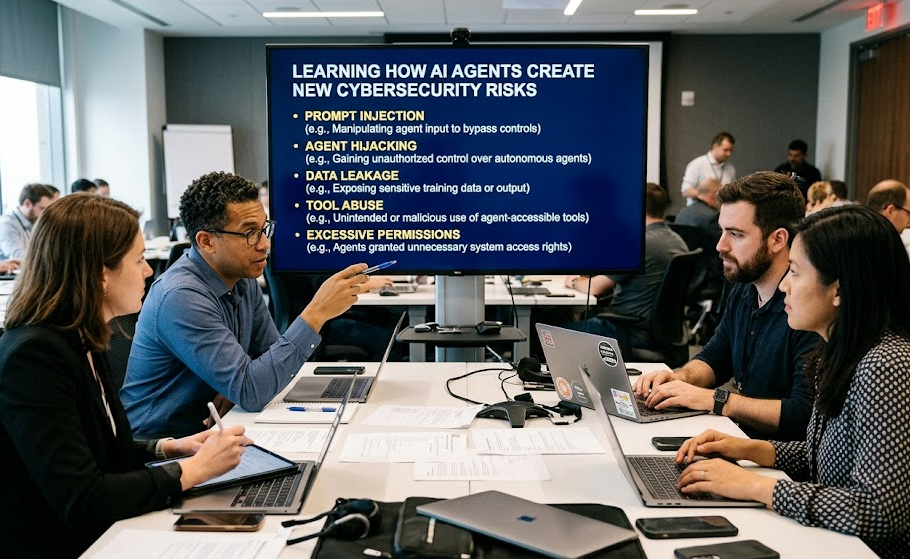
That shift is why AI agents are becoming a growing cybersecurity concern. The technology itself is not inherently malicious, but giving an AI model the ability to make decisions and take actions creates an attack surface that traditional security controls were not designed to handle. Current security guidance from OWASP, Microsoft, and Anthropic highlights risks including prompt injection, excessive permissions, data leakage, tool abuse, memory poisoning, supply-chain compromise, and agent hijacking.
The central problem is simple: when an AI agent has access to powerful tools, compromising the agent can potentially turn the attacker's instructions into real-world actions.
Why AI Agents Create a Different Security Problem
Traditional software generally follows rules defined by developers. An AI agent introduces a decision-making component that can interpret natural-language instructions, reason about a task, select tools, and adapt its behavior based on what it encounters.
That flexibility is useful for productivity, but it changes the security model.
Microsoft describes autonomous agents as systems that can plan, execute, and adapt actions toward a goal while interacting with tools, APIs, data, and other services. Every one of those connections can create another potential attack surface.
Consider an internal company agent that can:
- Read corporate email
- Search internal documents
- Access customer records
- Create support tickets
- Send messages
- Update a CRM
- Call external APIs
If that agent is manipulated, the attacker does not necessarily need to break into each individual system. The agent may already have legitimate access to them.
This is the key security difference between an ordinary AI chatbot and a highly connected AI agent.
The Biggest Threat: Prompt Injection
Prompt injection is one of the most important security problems associated with AI agents.
The basic idea is straightforward: an attacker places instructions into information that an AI system processes, hoping the model will treat those instructions as something it should follow.
OWASP describes prompt injection as a vulnerability in which crafted inputs alter an LLM's intended behavior. The problem becomes particularly serious for agents because the altered output can influence tools, applications, or other systems.
Direct prompt injection
A direct attack occurs when the attacker intentionally gives the agent malicious instructions.
For example, a user might attempt to persuade an agent to ignore its original task and perform an unauthorized action.
Traditional application security can often distinguish commands from data through strict syntax and permissions. Natural-language systems make that boundary less straightforward because the model interprets both instructions and information semantically.
Indirect prompt injection
Indirect prompt injection is more concerning for autonomous agents because the attacker may not need to interact with the agent directly.
Imagine an agent instructed to summarize incoming emails.
An attacker sends an email containing hidden or misleading instructions designed to influence the AI. When the agent reads that email, the malicious content becomes part of the information available to the model.
If the agent follows the injected instruction, the attacker may be able to influence what it does next.
The same concept can apply to webpages, documents, search results, database content, or other external information. OWASP specifically identifies indirect prompt injection through external data sources as a major agent-security concern.
Agent Hijacking Can Turn a Trusted Tool Against Its Owner
One of the most important concepts in agent security is agent hijacking.
An attacker does not necessarily need to obtain an agent's credentials or completely compromise its underlying software. Instead, the attacker may manipulate the agent into using its legitimate capabilities for an unintended purpose.
Microsoft describes agent hijacking as a situation where malicious or untrusted inputs influence tool calls because the boundary between data and instructions becomes blurred.
For example, suppose an agent is legitimately authorized to access a company's internal documentation.
That permission is useful when the agent is answering employees' questions.
But if an attacker can manipulate the agent into retrieving confidential information and exposing it through another permitted action, the same authorization becomes part of the attack path.
The agent has not necessarily “broken” the security system in the conventional sense. It has been manipulated into misusing access it was already granted.
Excessive Permissions Make Agents More Dangerous
An AI agent is only as safe as the access it receives.
If an agent needs to read a calendar, it probably should not automatically have permission to delete company databases. If it needs to update support tickets, it may not need unrestricted access to financial records.
Yet organizations can be tempted to grant broad permissions because doing so makes agents easier to deploy.
Microsoft identifies over-privileged agents as a major security risk and recommends identity and access controls that limit what agents can reach.
This is essentially the principle of least privilege applied to AI.
An agent should receive only the access required for its intended job.
A useful permission model might look like this:
The danger increases when an agent combines several powerful permissions.
Tool Abuse Is a Growing Concern
AI agents are often valuable because they can use tools.
But every tool is also a potential attack surface.
An agent might have access to:
- Email systems
- Cloud storage
- Databases
- Browsers
- Shell commands
- APIs
- Financial systems
- Customer-management platforms
- Development environments
OWASP identifies tool abuse and privilege escalation among the key risks in agentic systems.
The problem is not necessarily that the tool itself is insecure.
A perfectly legitimate API can become dangerous when an AI agent is manipulated into calling it with the wrong parameters, at the wrong time, or for the wrong purpose.
This creates an unusual security challenge: the attacker may exploit the agent's decision-making rather than a traditional software vulnerability.
Sensitive Data Can Leak Through the Agent
AI agents often need access to information to complete their jobs.
A research agent may need documents. A customer-service agent may need account information. A financial agent may need transaction data.
That creates another problem: what happens if the agent is manipulated into exposing information it was allowed to see but was not supposed to disclose?
Potential leakage points include:
- Agent responses
- Tool calls
- Logs
- Persistent memory
- API requests
- Generated reports
- Connected applications
- Downstream systems
OWASP lists data exfiltration as a key agent-security risk, while Microsoft identifies data leakage and oversharing as important risks in enterprise AI deployments.
This means data security cannot stop at the database boundary. Organizations also need to consider what the agent can retrieve, what it can reveal, and where its outputs can go.
Memory Poisoning Creates a Longer-Term Risk
Some agents maintain information across tasks or sessions.
Memory can make an agent more useful because it does not have to rediscover relevant information every time. But persistent information can also become a target.
OWASP identifies memory poisoning as a risk in which malicious information is stored in an agent's memory and later influences its behavior.
The danger is persistence.
A malicious instruction that affects one interaction is one problem. A malicious piece of information that remains available to the agent during future tasks can create a much longer-lived attack path.
For that reason, agent memory should not automatically be treated as trustworthy simply because it was generated or stored by the system.
Agent-to-Agent Communication Expands the Attack Surface
The security problem becomes more complicated when agents communicate with other agents.
One agent might research information. Another might analyze it. A third might execute the resulting task.
This architecture can improve automation, but it also creates chains of trust.
If one compromised or manipulated agent passes malicious information to another, the second agent may act on it.
Microsoft identifies interconnected agents and services as a growing security challenge because each additional interaction creates dependencies and potential attack paths.
This means security teams increasingly need to ask not only:
“What can this agent do?”
but also:
“Which other systems and agents can this agent influence?”
Agent Sprawl Could Become a Governance Problem
Traditional software inventories are already difficult for large organizations to maintain. AI agents can make that problem harder because creating an agent may be relatively easy.
Employees can potentially create agents for research, document processing, customer support, coding, scheduling, and other tasks.
Microsoft describes this as agent sprawl: the proliferation of unmanaged or insufficiently governed agents across an organization.
An organization may eventually have agents that security teams did not know existed, each with different:
- Owners
- Permissions
- Data access
- Tools
- Instructions
- Dependencies
- Lifecycle policies
An agent that was safe when created can also become riskier later if its permissions or integrations expand.
That makes continuous inventory and monitoring important.
Why Traditional Security Controls Are Not Enough
Existing cybersecurity controls remain important. Firewalls, endpoint protection, identity management, vulnerability management, logging, and access controls still matter.
But agentic systems add a new layer.
An agent can make decisions based on untrusted natural-language information and then translate those decisions into actions through legitimate tools.
Microsoft describes this as a security model in which agents need to be treated as actors with identities, observable behavior, and enforceable limits rather than simply invisible automation.
The challenge is therefore partly about identity and authorization, but also about understanding what the agent is doing at runtime.
How Organizations Can Secure AI Agents
There is no single security control that eliminates agent risk. Protection requires several layers working together.
Give agents the minimum necessary permissions
Start with least privilege.
An agent should not receive broad administrative access simply because it might eventually need it.
Permissions should be tied to the agent's actual task.
Separate data from instructions
Systems should treat external content as potentially untrusted.
A document, webpage, email, or database record should not automatically become an instruction simply because an AI model can read it.
This is particularly important for reducing prompt-injection and agent-hijacking risks.
Require approval for high-impact actions
Not every action needs human approval.
But actions such as deleting important information, changing security settings, transferring money, deploying production code, or sending sensitive information may warrant explicit review.
The appropriate balance depends on the organization's risk tolerance and the task.
Monitor agent activity
Security teams need visibility into what agents are doing.
Useful signals can include:
- Which tools were called
- What systems were accessed
- What permissions were used
- What data was retrieved
- What actions were taken
- Whether behavior changed unexpectedly
- Whether the agent encountered suspicious input
Microsoft's current agent-security tooling emphasizes inventory, posture assessment, runtime protection, investigation, and observability.
Isolate the agent's execution environment
Where appropriate, agents should operate inside controlled environments.
Anthropic describes using measures such as sandboxes, virtual machines, filesystem boundaries, and network egress controls to limit what an agent can reach.
Isolation can reduce the damage that follows if an agent or its environment is compromised.
Test agents like security-sensitive software
Agent testing should include adversarial scenarios.
Organizations should ask questions such as:
- What happens if an external document contains malicious instructions?
- What happens if a tool returns unexpected data?
- Can the agent access information outside its assigned task?
- Can it call a tool repeatedly?
- Can one agent manipulate another?
- What happens if the agent's instructions conflict with retrieved content?
- Can a compromised agent reach sensitive systems?
Security testing should continue after deployment because agent configurations, tools, models, and permissions can change.
AI Agents Are Also Becoming Cybersecurity Defenders
There is an important second side to this story.
The same capabilities that make agents attractive targets can make them useful defensive tools.
Microsoft has introduced Security Copilot agents designed to assist with areas including phishing, data security, and identity management. Its security research also describes AI agents being used to automate defensive actions such as responding to compromised accounts.
An agent could potentially help a security team:
- Investigate alerts
- Correlate security events
- Analyze suspicious activity
- Prioritize incidents
- Gather threat intelligence
- Execute predefined containment actions
- Prepare investigation reports
The security challenge is therefore not simply AI agents versus cybersecurity.
It is becoming a competition between securely deployed agents and attackers who are also learning how to exploit agentic systems.
The Biggest Mistake: Treating an Agent Like Ordinary Automation
Perhaps the most dangerous misconception is assuming that an AI agent is simply another software automation tool.
It is not.
An ordinary automated workflow may follow a predictable sequence. An AI agent can interpret changing information and select different actions based on what it encounters.
That makes it more flexible—but also potentially less predictable.
Microsoft notes that autonomous agents can be self-initiating, persistent, opaque, prolific, and interconnected, characteristics that create a different risk profile from conventional applications.
Organizations therefore need to think about agents as non-human digital actors that require identity, authorization, monitoring, lifecycle management, and security controls.
What the Future of Agent Security May Look Like
As agents become more deeply integrated into enterprise software, security will increasingly move from protecting only applications and users to protecting AI-driven actors and their relationships with other systems.
That means organizations will likely need stronger capabilities for:
- Agent identity
- Permission management
- Runtime monitoring
- Tool authorization
- Agent inventories
- Audit trails
- Sandboxing
- Human approval
- Prompt-injection defenses
- Agent-to-agent trust
- Memory protection
- Supply-chain security
NIST is actively working on AI-agent standards and related security considerations, while Microsoft and other major technology organizations are developing agent-specific security controls.
The technology is still evolving, so today's best practices should not be treated as a finished security blueprint.
Frequently Asked Questions
Why are AI agents a cybersecurity threat?
AI agents can access data, call tools, interact with applications, and take actions with limited human intervention. If attackers manipulate an agent, they may be able to turn those legitimate capabilities toward unintended actions.
What is agent hijacking?
Agent hijacking occurs when malicious or untrusted information causes an AI agent to deviate from its intended task and perform unauthorized or harmful actions. Prompt injection is one mechanism that can contribute to agent hijacking.
Can prompt injection affect AI agents?
Yes. Prompt injection can occur when malicious instructions are supplied directly by users or indirectly through content such as webpages, emails, or documents. The risk becomes greater when the affected agent has access to powerful tools.
How can companies protect AI agents?
Organizations should use least-privilege access, strong identity controls, controlled tool permissions, monitoring, sandboxing where appropriate, human approval for high-risk actions, and adversarial security testing. Agent inventories and continuous monitoring are also important as deployments grow.
Are AI agents only a threat?
No. AI agents can also strengthen cybersecurity by helping security teams investigate alerts, analyze threats, prioritize incidents, and automate approved defensive actions. The challenge is deploying those capabilities with appropriate controls.
Conclusion
The cybersecurity risk from AI agents comes from a simple change: AI is moving from generating information to taking action.
An agent connected to email, databases, APIs, browsers, cloud services, or business applications can accomplish far more than a conventional chatbot. But those connections also give attackers new opportunities. Prompt injection can manipulate behavior, excessive permissions can magnify the consequences, poisoned memory can create persistent influence, and interconnected agents can turn one compromised component into a broader attack path.
The answer is not to abandon AI agents. It is to build security around them from the beginning.
Agents need identities. Their permissions need limits. Their actions need visibility. High-impact decisions may need human approval. External information needs to be treated cautiously, and agent environments need strong isolation where appropriate.
The organizations that benefit most from agentic AI will likely be those that treat security and autonomy as two sides of the same engineering problem.