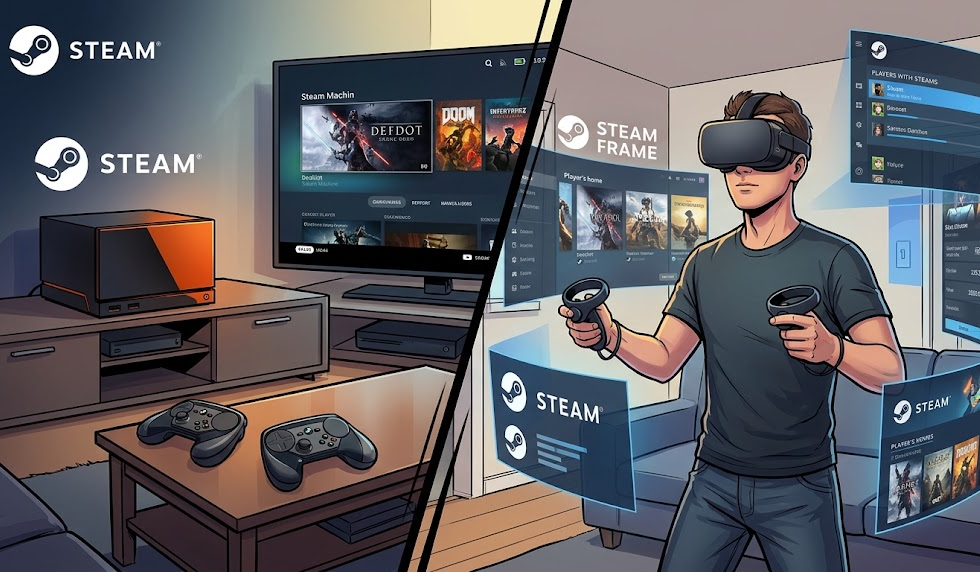
Valve is taking Steam in two very different directions with its latest hardware. The Steam Machine is a compact SteamOS gaming PC designed to sit beside a TV or monitor, while the Steam Frame is a lightweight standalone and PC-streaming VR headset designed to put Steam games around you rather than simply in front of you.
That makes a direct Steam Machine vs Steam Frame VR headset comparison slightly unusual. These products are not competing for exactly the same job. The Steam Machine is the better choice for conventional gaming, local PC performance and living-room use. The Steam Frame is the more interesting option if your priority is VR, wireless PC gaming and a portable headset that can also run compatible games locally.
There is also an important distinction in timing. The Steam Machine launched in June 2026, while Valve has continued preparing the Steam Frame for launch without publishing a final retail price or firm release date as of September 2026. Valve originally positioned both products as 2026 hardware.
Steam Machine vs Steam Frame at a glance
The hardware specifications show the fundamental difference: the Steam Machine is a small desktop computer with a discrete-style AMD graphics architecture, while the Steam Frame puts a mobile processor, displays, tracking hardware and battery into a headset weighing roughly 435 grams.
What is the Steam Machine?
The Steam Machine is Valve's return to the living-room PC concept.
Rather than asking users to assemble a gaming computer and connect it to a television, Valve sells the Machine as a compact SteamOS-based computer. It can be connected to a TV or monitor and used much like a console, while retaining the flexibility of a PC-based Steam system.
The current hardware uses a semi-custom AMD Zen 4 processor with six cores and 12 threads, alongside a semi-custom RDNA 3 GPU. The graphics hardware has 8GB of dedicated GDDR6 VRAM, while the system has 16GB of DDR5 memory. Storage options are 512GB and 2TB.
The physical design is one of its biggest attractions. The system measures approximately 15.2 × 15.6 × 16.2 cm, making it substantially smaller than a conventional gaming desktop.
Valve priced the 512GB version at $1,049, while the 2TB model costs $1,349. A Steam Controller can be added for an additional $79.
The price is significant because the Steam Machine is not trying to be the cheapest way to obtain PC gaming performance. Its appeal comes from the combination of compact hardware, SteamOS integration and a console-like living-room experience.
What is the Steam Frame?
The Steam Frame takes the SteamOS concept into virtual reality.
Valve designed it as a hybrid headset. It can run compatible games using its own hardware, but it can also stream higher-fidelity PC games wirelessly from a gaming PC. This means it is not simply a successor to the older wired Valve Index.
The Steam Frame uses a Qualcomm Snapdragon 8 Gen 3 processor and 16GB of LPDDR5 memory. Its displays provide 2160 × 2160 pixels per eye, with pancake optics and a field of view of up to 110 degrees. Valve's announced refresh-rate options include 72Hz, 90Hz and 120Hz, with 144Hz described as experimental.
Storage is planned in 256GB and 1TB configurations. The headset also has six cameras: four exterior monochrome cameras for computer-vision tracking and two internal cameras for eye tracking.
The most striking number is its weight. The headset is around 435 grams, considerably lighter than the approximately 515-gram Meta Quest 3 figure cited by PC Gamer. Valve has also identified a much lighter 185- to 190-gram core module containing the primary computing and display hardware.
The biggest difference: they solve different problems
This is the key to the entire comparison.
If you want to sit on a couch, connect a controller and play conventional Steam games on a television, the Steam Machine is the obvious choice.
If you want to put on a headset and play VR games, use virtual environments or stream PC games wirelessly into VR, the Steam Frame is the appropriate device.
Trying to determine which is "more powerful" without considering the use case is therefore misleading.
The Steam Machine has much more substantial graphics hardware because it is a small desktop PC. The Steam Frame does not need to render a conventional 2D game at the same scale because it is designed around a very different computing environment.
Steam Machine vs Steam Frame: performance
Steam Machine is the clear choice for traditional gaming
The Steam Machine has a dedicated AMD RDNA 3 GPU with 8GB of GDDR6 VRAM. That makes it fundamentally different from the mobile-style graphics architecture inside the Steam Frame.
For ordinary PC games running on a television or monitor, the Steam Machine therefore has the hardware architecture you would expect from a dedicated gaming computer.
Independent reviews have found the Steam Machine capable of delivering a strong console-like experience, although reviewers have also criticized its value and noted that it does not compete with the fastest gaming PCs.
It is important not to interpret that as meaning the Machine is a poor gaming computer. Its purpose is more specific: provide a compact SteamOS gaming system without requiring the user to build a PC.
Steam Frame prioritizes VR efficiency and streaming
The Steam Frame has a very different performance strategy.
Its Snapdragon 8 Gen 3 processor allows the headset to operate independently for supported games, while Valve has developed wireless streaming technology for more demanding PCVR experiences.
Valve has said the headset is designed around wireless streaming, including a dedicated wireless adapter and a dedicated radio for streaming. It also uses a technology called Foveated Streaming, which is intended to reduce the amount of image data that needs to be transmitted at full detail.
In simple terms, the Steam Machine does more of the heavy rendering itself. The Steam Frame can shift demanding rendering work to another PC and send the resulting experience wirelessly to the headset.
Display and immersion
This category belongs entirely to the Steam Frame.
The Steam Machine does not have a display. You choose the television or monitor.
The Steam Frame has two LCD panels, one for each eye, each providing 2160 × 2160 resolution. It also uses pancake lenses, a modern optical design that can allow a thinner headset than older Fresnel-lens designs.
That makes the two devices fundamentally different experiences.
The Steam Machine gives you a traditional screen-based gaming session.
The Steam Frame gives you a three-dimensional environment that can surround your vision.
For someone who primarily wants VR, the Machine cannot replace the Frame regardless of how much faster its graphics hardware is.
Steam Frame's standalone advantage
One of the most interesting aspects of Valve's headset is that it does not require a gaming PC for every experience.
The Snapdragon 8 Gen 3 and SteamOS allow the Frame to run compatible software locally. Valve and Steam have also been building a verification system specifically for Frame compatibility, reflecting the different requirements of running games directly on headset hardware.
This matters because standalone VR has a major convenience advantage.
A traditional PCVR headset can deliver high-quality graphics, but the computer has to do the rendering and the headset has to receive the video signal. The Frame attempts to combine the convenience of standalone VR with the ability to access more demanding PC gaming through wireless streaming.
That hybrid design is arguably the most important idea behind the product.
Steam Machine vs Steam Frame for PCVR
If your main interest is high-end PCVR, the answer becomes more nuanced.
The Steam Machine can serve as the gaming PC that provides the rendering power. The Steam Frame can then act as the wireless VR display and input device.
That means the two products are not necessarily alternatives. In some setups, they could complement one another.
Valve's approach is particularly interesting because the Frame is designed to stream from a local PC or Steam Machine without relying on a traditional physical video cable. Ars Technica reported that Valve was focusing on wireless streaming rather than offering a wired PC connection.
For a user who wants a dedicated living-room Steam system and VR, a Steam Machine plus Steam Frame could therefore form a complete Valve-focused gaming setup.
The downside is obvious: buying two premium hardware products is much more expensive than buying either one individually.
Steam Machine vs Steam Frame for portability
The Steam Frame wins easily.
The Steam Machine is compact for a desktop PC, but it is still a stationary computer. You need a display, power and usually a controller or keyboard and mouse.
The Steam Frame contains its own displays, processing hardware, tracking system, speakers and battery.
Its approximately 435-gram weight is one of its strongest physical advantages.
It can therefore be moved from room to room without carrying a complete gaming computer and display.
That does not make it equivalent to a Steam Deck. VR has its own physical requirements, and battery-powered headsets remain constrained by battery capacity and thermal limits.
Storage comparison
The Steam Machine offers 512GB or 2TB of storage. The Steam Frame is planned with 256GB or 1TB options.
The difference matters because the role of storage is not identical.
On the Steam Machine, a 2TB model is useful for maintaining a large traditional PC game library locally.
On the Steam Frame, the 256GB configuration may make more sense for someone who expects to stream many demanding games from a PC, while the 1TB model is more attractive to users who want to install more compatible standalone software directly on the headset.
That is a use-case distinction rather than a simple "bigger is better" comparison.
Which device has better graphics?
For traditional games rendered locally, the Steam Machine has the clear hardware advantage.
Its AMD RDNA 3 GPU and 8GB of dedicated GDDR6 VRAM are designed for desktop-class gaming workloads. The Steam Frame's Snapdragon 8 Gen 3 is a mobile-oriented platform designed to operate within the thermal and power constraints of a headset.
But graphics quality on the Steam Frame can be much higher when the headset streams from a capable PC.
In that situation, the headset is not doing all the heavy rendering itself. The remote PC renders the game and sends the resulting imagery to the Frame.
So the right question is not simply "Which has better graphics?"
It is:
Do you want a standalone gaming computer, or a VR headset that can also become a wireless window into a much more powerful PC?
Which one is easier to use?
The Steam Machine is likely to feel more familiar to anyone who has used a console or desktop PC.
Connect it to a TV, sign into Steam, install games and use a controller.
The Steam Frame introduces additional considerations because VR involves headset positioning, tracking, play space, controllers and wireless networking.
Valve's goal is clearly to reduce that friction. SteamOS provides a common software environment, while the headset uses inside-out tracking rather than requiring external tracking stations. PC Gamer lists the Frame as using inside-out tracking.
Even so, VR will always involve more physical setup than conventional television gaming.
Price and value
The Steam Machine has a known price, while the Steam Frame's final retail pricing remains an unresolved part of the comparison as of September 2026.
The Steam Machine starts at $1,049 for 512GB, with a $1,349 2TB model. A Steam Controller bundle adds $79.
Valve has not officially published a final Steam Frame price in the sources available for this comparison. Reports continue to indicate that launch preparations are underway, including evidence of a possible reservation system, but the price should not be guessed.
That makes direct price-per-performance comparisons premature.
For the Steam Machine, the value question is whether its compact design and SteamOS experience justify paying more than a comparable DIY or conventional Windows gaming PC.
For the Steam Frame, the eventual price will determine how competitive it is against products such as the Meta Quest 3.
Which one should you buy?
Choose the Steam Machine if...
The Steam Machine is the better choice if you:
- Mainly play traditional PC games.
- Want to game on a TV or monitor.
- Prefer a console-like experience.
- Want substantially more graphics hardware than a standalone VR headset.
- Already own a TV and don't need another display.
- Want a compact SteamOS desktop.
- Prefer not to build a gaming PC yourself.
It is particularly appealing to someone who sees the Steam Deck as a portable PC and wants a significantly more powerful machine for home gaming.
Choose the Steam Frame if...
The Steam Frame makes more sense if you:
- Primarily want VR gaming.
- Want wireless PCVR.
- Prefer a standalone headset.
- Value low headset weight.
- Want to run supported Steam games locally without a separate PC.
- Want a headset that can also stream demanding PC games.
- Are interested in Valve's approach to SteamOS-based VR.
If VR is not part of your gaming routine, however, much of what makes the Frame special simply will not matter.
Could you use both?
Yes, and this may ultimately be the most interesting scenario.
The Steam Machine can provide the computing power for demanding games, while the Steam Frame can provide the VR interface.
Instead of seeing them as competing products, think of them as two ends of the same Steam ecosystem.
The Machine is the computer.
The Frame is the immersive display and VR interface.
Valve's wireless PCVR strategy makes this relationship especially relevant. The company has designed the Frame around low-latency wireless streaming rather than treating it as simply another wired PCVR headset.
Whether buying both makes financial sense will depend heavily on the Frame's final price and the games you intend to play.
Steam Machine vs Steam Frame: the verdict
There is no universal winner because the two products are designed around different forms of gaming.
The Steam Machine is the better choice for conventional gaming. It has a much more substantial graphics architecture, connects directly to a television or monitor and behaves like a compact SteamOS gaming PC. Its biggest weaknesses are its relatively high price and the fact that similarly priced traditional PCs can offer stronger hardware.
The Steam Frame is the better choice for VR. Its 2160 × 2160-per-eye displays, pancake optics, standalone Snapdragon processor, inside-out tracking and wireless PC streaming make it a fundamentally different kind of Steam device.
The most useful way to make the decision is therefore simple:
Buy the Steam Machine for the biggest conventional Steam gaming experience in a small box. Buy the Steam Frame for immersive VR and wireless access to PC gaming.
And if you want both conventional and VR gaming in one Valve-centered setup, the two products may actually make more sense together than they do as rivals.
Frequently Asked Questions
Is the Steam Machine more powerful than the Steam Frame?
For traditional gaming, yes. The Steam Machine uses a semi-custom AMD RDNA 3 GPU with 8GB of dedicated GDDR6 VRAM, while the Steam Frame uses a Snapdragon 8 Gen 3 mobile platform.
Can the Steam Frame play games without a Steam Machine?
Yes, for supported software. The Steam Frame has its own Snapdragon processor, memory and SteamOS environment, allowing compatible games and applications to run locally. It can also stream more demanding games from another PC.
Can the Steam Machine be used for VR?
The Steam Machine is a gaming PC rather than a VR headset. It can potentially provide the computing side of a PCVR setup when paired with compatible VR hardware, but it does not provide the headset, displays or tracking itself.
Which is better for 4K gaming?
The Steam Machine is the relevant choice because it is designed to connect to an external display and has dedicated AMD graphics hardware. The Steam Frame is designed around VR displays rather than conventional 4K television gaming.
How much does the Steam Frame cost?
Valve had not published a confirmed retail price for the Steam Frame as of September 2026. Reports indicate that Valve is preparing for launch, but its final price should be verified from Valve before publication or purchase.
Conclusion
The Steam Machine and Steam Frame may have appeared together in Valve's hardware announcements, but they represent two very different ideas about where PC gaming should happen.
The Steam Machine turns Steam into a compact living-room computer. Its strength is conventional gaming performance, straightforward TV connectivity and a console-like SteamOS experience.
The Steam Frame takes Steam into VR. Its lightweight design, high-resolution displays, standalone processing and wireless PC-streaming capabilities are aimed at players who want immersion rather than simply a faster conventional gaming box.
For most traditional PC gamers, the Steam Machine is the more logical purchase. For VR enthusiasts, the Steam Frame is the much more relevant device. And for someone who wants both, Valve's ecosystem becomes more interesting because the two devices can potentially complement each other rather than compete directly.
The final deciding factor for the Frame will be its retail price and availability. Until Valve confirms those details, the Steam Machine is the easier product to evaluate on value, while the Frame remains the more intriguing option for people specifically looking for a new approach to PCVR.