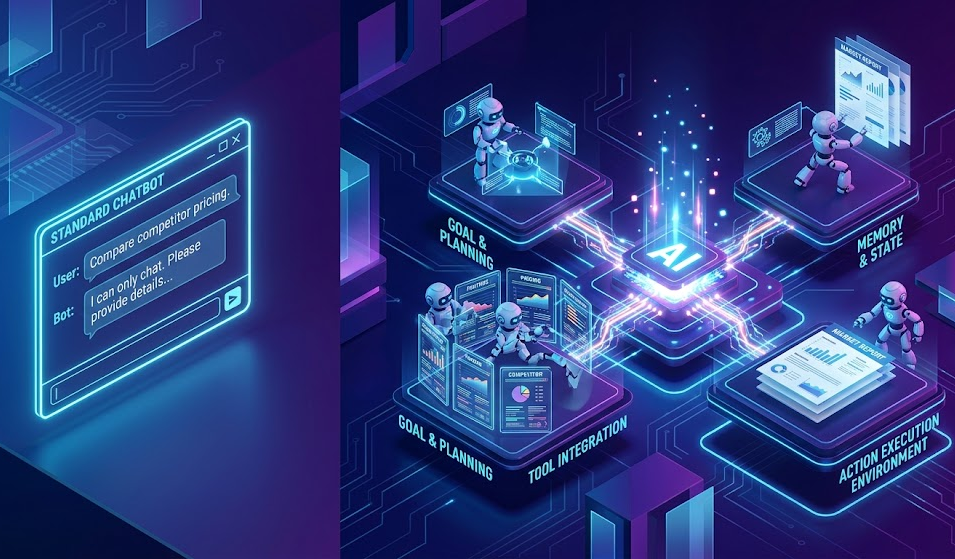
Imagine asking an AI system to “research five competitors, compare their pricing, summarize the differences, and put the findings into a report.” A traditional chatbot might help with the research and write the report, but an AI agent can go a step further: it can decide which information it needs, use approved tools to gather it, evaluate what it finds, perform additional steps, and continue until the assigned task is completed or human approval is required.
That difference—moving from generating an answer to taking a sequence of goal-directed actions—is at the heart of AI agents. Modern agent systems commonly combine an AI model with tools, planning or orchestration, memory or state, and an execution environment.
What Are AI Agents?
AI agents are software systems designed to pursue a goal by interpreting information, deciding what actions to take, using available tools, and evaluating the results. Unlike a basic chatbot that primarily responds to a prompt, an agent can operate through a multi-step loop: understand the goal, plan, act, observe the outcome, and adjust its next action.
The exact definition varies across the industry and research literature, because “agent” can describe systems with very different levels of autonomy. Some agents perform narrowly defined tasks, while others can coordinate multiple tools and steps. Current research commonly examines capabilities such as tool use, planning, memory, reasoning, feedback, and interaction with an environment.
A useful way to think about the distinction is:
The boundaries are not absolute. An application may contain chatbot, assistant, workflow, and agent-like components at the same time.
How Do AI Agents Work?
At a high level, an AI agent works as a continuous decision-and-action system.
A typical workflow looks like this:
Goal → Understand → Plan → Use tools → Observe results → Evaluate → Act again → Complete or request approval
This is often called an agent loop. Microsoft's current documentation, for example, describes agents as systems that gather context, take actions, evaluate results, and repeat the process as needed. Anthropic similarly describes an agent as operating in a self-directed loop of planning, acting, observing, adjusting, and repeating.
1. The user or system provides a goal
Everything begins with an objective.
For example:
“Find three suitable laptops for video editing under my specified budget and prepare a comparison.”
The goal is more important than a single question because the agent needs to determine what actions are required to reach the desired outcome.
An agent may receive the goal directly from a person, a scheduled event, an application, or another system.
2. The AI model interprets the task
A large language model or another AI model typically acts as the reasoning component.
It interprets the request, identifies relevant information, considers available options, and decides what should happen next. Modern agent architectures can also use multimodal models capable of working with combinations of text, images, audio, video, or code.
The model itself, however, is not necessarily the entire agent.
An important distinction is that the model generates decisions or instructions, while the surrounding agent system provides the tools, state, permissions, and execution environment needed to act on them.
3. The agent creates or updates a plan
Complex tasks are often divided into smaller steps.
For the laptop example, the agent might determine that it needs to:
- Identify appropriate products.
- Collect relevant specifications.
- Check prices from permitted sources.
- Compare the candidates.
- Remove options that fail the requirements.
- Produce the final comparison.
Planning does not always mean producing a fixed list of steps at the beginning. An agent can revise its plan after receiving new information.
Research into LLM-based agents identifies planning as one of the major capabilities used to support multi-step tasks, including areas such as web navigation, travel planning, and database querying.
4. The agent uses tools
Tools are what allow an AI agent to move beyond conversation.
Depending on the system, tools may include:
- Web search
- Databases
- APIs
- Calculators
- Code execution
- File systems
- Business applications
- Email or messaging systems
- Browsers
- Enterprise knowledge bases
- Software development environments
Google's description of agent architecture separates the AI model from the tools that determine what an agent can actually do.
For example, an AI model may know how to formulate a database query, but the agent's tool layer is what gives it controlled access to the database.
That distinction becomes especially important for security. Giving an AI system access to a tool also gives it a potential pathway to affect the outside world.
5. The agent observes the result
After taking an action, the agent receives an outcome.
Suppose it searches a website and discovers that a product is unavailable. That result changes the situation. The agent may need to search another source or select a different product.
This feedback loop separates many agent systems from simple one-shot AI generation.
Instead of:
Prompt → Answer
the process can look more like:
Goal → Action → Result → Decision → Action → Result → Decision
The agent keeps using new information to determine what should happen next.
6. The agent evaluates whether it is finished
The system needs some way to determine whether the task has been completed successfully.
Depending on the application, completion may mean:
- A required document was created.
- A database record was updated.
- A software test passed.
- A requested calculation was completed.
- A workflow reached its final state.
- A human approved the final action.
If the result is inadequate, the agent can attempt another step instead of immediately returning an answer.
This ability to evaluate and repeat is one reason agent systems can handle tasks that would be cumbersome to perform manually one step at a time.
What Are the Main Components of an AI Agent?
Although architectures differ, modern AI agents commonly contain several building blocks.
AI model
The model acts as the central reasoning or decision-making component. In many current systems, this is an LLM.
It interprets instructions and available context and produces the next decision, response, or tool call.
Tools
Tools give an agent capabilities beyond generating text.
A customer-service agent, for example, might have access to an order database, while a coding agent could have access to files, a terminal, testing tools, and version-control systems.
Memory and state
An agent may need to remember information during a task or across interactions.
Memory can include the current conversation, previous tool results, task state, retrieved documents, user-provided information, or other application data.
However, “memory” does not necessarily mean that the AI permanently remembers everything it encounters. The implementation determines what information is stored, for how long, and under what controls.
Planning and orchestration
The orchestration layer coordinates the model, tools, information, and workflow.
Google describes orchestration as the mechanism that helps an agent plan and connect components during multi-step work.
Grounding and external information
Agents may retrieve information from trusted sources rather than relying exclusively on what the underlying model learned during training.
Retrieval-augmented generation, databases, internal documents, and APIs can all provide additional context.
Runtime or execution environment
An agent needs somewhere to operate.
That might be a cloud environment, a development workspace, a browser environment, an enterprise platform, or another controlled runtime.
The runtime determines what the agent can access and what actions it is technically capable of performing.
AI Agents vs. Chatbots: What's the Difference?
The distinction is easiest to understand through the amount of independent work involved.
A chatbot might receive:
“Summarize this document.”
It processes the document and returns a summary.
An agent might receive:
“Review these documents, identify unresolved issues, check the relevant records, prepare a report, and create follow-up tasks.”
The agent potentially needs to:
- Read multiple sources.
- Determine what information is missing.
- Query another system.
- Compare results.
- Create an output.
- Take additional actions.
- Ask for human approval where required.
That does not mean every agent is fully autonomous. In fact, responsible agent systems often deliberately place humans in control of important actions.
OpenAI's current description of workspace agents, for example, emphasizes approved tools and integrations, while noting that agents remain bounded by instructions, tools, and guardrails.
AI Agents vs. Traditional Automation
Traditional automation generally follows a predefined path.
For example:
If an email arrives → extract attachment → save attachment → send notification.
The workflow is largely predetermined.
An AI agent can be more flexible. It may interpret the contents of an email, determine what type of request it contains, choose an appropriate tool, and adapt its next step according to what it discovers.
This flexibility comes with a trade-off.
Traditional automation is often easier to predict because its logic is explicitly specified. Agentic systems are more probabilistic because an AI model participates in decision-making. OpenAI describes this distinction as one between deterministic workflows and more probabilistic agent behavior.
For highly predictable processes, conventional automation may therefore remain the better choice.
What Are AI Agents Used For?
AI agents are particularly useful when a task involves multiple steps, changing information, and interaction with external tools or systems.
Software development
Coding agents can inspect project files, modify code, run tests, analyze errors, and make further changes.
The important difference is that the system is not limited to suggesting code in a chat window. It can participate in an execution-and-feedback cycle inside an authorized development environment.
Research and information gathering
An agent can potentially search multiple sources, collect information, compare findings, and organize the results.
This is useful when the task requires more than answering a single factual question.
However, agentic research still requires source verification. An agent can make incorrect decisions or rely on inaccurate information, so autonomy should not be confused with guaranteed accuracy.
Customer support
Agents can interpret customer requests, retrieve account or order information, classify problems, and initiate approved workflows.
More sensitive actions may still require human review.
Business workflows
Agents can work with tools such as customer relationship management systems, ticketing platforms, internal documentation, and communication applications. OpenAI's current workspace-agent documentation gives examples including Slack, CRM systems, internal documentation, and ticketing systems.
Data and analysis tasks
An agent can combine retrieval, calculations, code execution, and reporting to handle multi-step analytical workflows.
The usefulness depends heavily on the quality of the underlying data and the controls surrounding the tools.
What Are the Benefits of AI Agents?
The main advantage is not simply that an agent can “think.” The practical benefit is that it can coordinate multiple steps toward a goal.
Less manual coordination
Instead of manually moving information between several tools, an agent may coordinate those steps itself.
Handling complex workflows
Tasks involving research, retrieval, analysis, execution, and verification can potentially be combined into one workflow.
Adaptability
Because the agent can react to intermediate results, it does not necessarily have to follow exactly the same sequence every time.
Tool integration
Agents can connect AI reasoning with software systems and data sources, allowing them to perform actions rather than simply produce text.
Potential productivity gains
When a task is repetitive, structured, and tool-based, agents can reduce the amount of manual coordination required. OpenAI's current guidance similarly identifies repeatable, structured, time-based, and tool-based work as particularly suitable for agents.
What Are the Limitations and Risks?
The ability to act is also what makes AI agents more complicated than ordinary chatbots.
Incorrect decisions
An agent can misunderstand a goal, select an unsuitable tool, misinterpret information, or stop at the wrong point.
A fluent response does not prove that the underlying action was correct.
Prompt injection and agent hijacking
One major security problem occurs when an agent encounters malicious instructions inside information it processes.
For example, an agent might retrieve a web page containing hidden or misleading instructions intended to influence its behavior. NIST describes this type of attack as indirect prompt injection and has specifically studied agent hijacking risks.
Excessive permissions
An agent with access to email, financial systems, databases, source code, or administrative tools can potentially cause much greater damage than a chatbot that can only generate text.
NIST has highlighted the need for identity and authorization controls because agents may have access to diverse datasets, tools, and applications.
Privacy concerns
Agents may process sensitive business or personal information. Organizations therefore need to control what information agents can access, retain, and transmit.
Unpredictable behavior
Because model-based decision-making is probabilistic, two similar situations do not always guarantee identical behavior.
This makes testing, monitoring, logging, permissions, and human oversight particularly important.
NIST's 2026 analysis of AI-agent security responses found broad agreement that agents introduce novel security threats and that existing cybersecurity practices need adaptation to address them effectively.
Common Misconceptions About AI Agents
“Every AI chatbot is an AI agent”
Not necessarily.
A chatbot can answer questions without independently planning and executing a sequence of external actions. Agent systems generally add capabilities such as tool use, state, planning, and iterative execution.
“AI agents are completely autonomous”
Autonomy exists on a spectrum.
An agent might require approval before sending an email, purchasing something, changing production code, or modifying important records.
“An AI agent is just an LLM”
Usually, no.
The model is an important component, but the complete system can also include tools, memory, orchestration, permissions, retrieval systems, and an execution environment.
“More autonomy is always better”
Not necessarily.
For a low-risk repetitive task, greater autonomy may be useful. For an irreversible or sensitive action, requiring human approval can be more appropriate.
The goal should be appropriate autonomy, not maximum autonomy.
When Should You Use an AI Agent?
An agent is a good candidate when a task has several of these characteristics:
- It involves multiple steps.
- The exact path may change depending on results.
- It requires external tools or data.
- It occurs repeatedly.
- The desired outcome can be clearly defined.
- Results can be evaluated.
- Appropriate permissions and safeguards can be established.
A conventional workflow may be preferable when every step is already known and predictable.
This is an important practical point: using an AI agent does not automatically make a workflow better. Sometimes a simple script or deterministic automation is cheaper, easier to test, and more reliable.
What Does the Future of AI Agents Look Like?
The technology is moving toward systems that can coordinate more tools, handle longer workflows, and work with other agents. Research already examines single-agent and multi-agent architectures, external tools, reasoning, planning, memory, and feedback mechanisms.
At the same time, security and governance are becoming central engineering problems rather than optional additions. NIST is developing work around AI-agent standards, interoperability, identity, authorization, and security.
That suggests the next stage of agent development will not be defined only by how much an AI can accomplish. It will also depend on whether developers can make those actions traceable, controllable, secure, and appropriately limited.
Frequently Asked Questions
Are AI agents the same as generative AI?
No. Generative AI describes systems that generate content such as text, images, audio, or code. AI agents can use generative AI models as their reasoning component, but add mechanisms for planning, tool use, state, and action.
Do AI agents use ChatGPT or large language models?
Many modern AI agents use large language models, but an agent does not have to be built around one specific model or product. The architecture can vary according to the task and application.
Can AI agents make decisions without humans?
Some can make bounded decisions without asking for approval at every step. However, responsible deployments can require human approval for sensitive or irreversible actions. The amount of autonomy should match the risk of the task.
Are AI agents safe?
They can be useful, but they are not automatically safe. Risks include incorrect actions, prompt injection, excessive permissions, privacy problems, and compromised tools or data. NIST specifically identifies security challenges that arise when AI models are connected to software systems and external actions.
What is an example of an AI agent?
A coding agent is one example. Given a high-level software task, it can inspect a project, plan changes, edit files, run tests, examine failures, and make additional changes within the permissions provided to it.
Conclusion
The easiest way to understand AI agents is to stop thinking of them as AI that only answers questions and start thinking of them as AI systems that can pursue goals through actions.
An agent typically combines an AI model with tools, information, memory or state, orchestration, and an execution environment. It can interpret a goal, decide what to do, perform an action, examine the result, and continue until the task is completed or human intervention is needed.
That flexibility makes agents useful for software development, research, customer support, business workflows, and other multi-step tasks. But it also creates new security and reliability challenges. The most effective agent systems will therefore not simply be those that can act independently—they will be those that know what they are allowed to do, when they should ask for help, and how their actions can be checked.